Life Peak Experiences and Collaboration

I promise, this isn’t going to turn into The Traveling Light Blog. Really, it isn’t.  I really do have other things to write about besides this. But, when life hands you Good Collaboration, you shout it from the mountaintops as much as possible, as well as wrap it up in cool cotton blankets and feed it nice things and take good care of it.

Yesterday afternoon, the cast (or, three-fourths, anyway; Kyra, Doug and Bob), the director and producer (Liam) and photographer and man-about-town Kyle Cassidy packed into the back of Toshiro Mifune (our tough, versatile and quiet Honda CRV) for a drive through the back alleys of South Philly, Grays Ferry, West Philadelphia, and finally, beautiful Mount Moriah Cemetery, for a photo shoot.

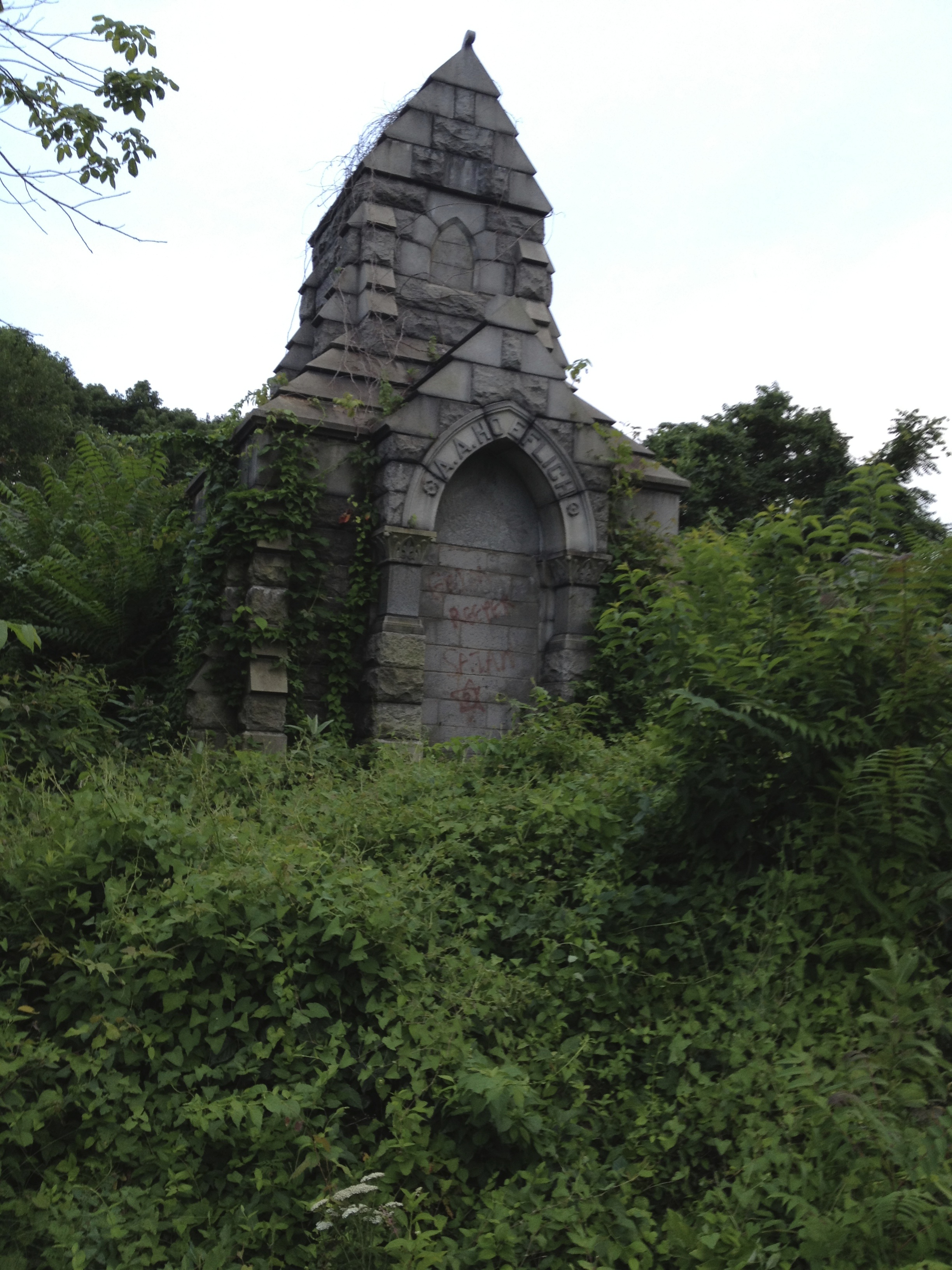
Mount Moriah Cemetery.

Mount Moriah Cemetery  is one of those things that everyone should know about, but when you go there, you want it to be kept a secret and only invite your few close friends who will be inspired with the same wonder and respect you do.  It inhabits a dreamlike between-space: its ownership is currently legally undetermined, it provides burial space to all faiths, its monuments are of many different aesthetic styles, and it’s wild and cultivated at the same time. The Friends of Mount Moriah Cemetery have established a volunteer committee, responsible for cleaning, gardening and care. However, its 200 acres and decades of neglect can’t be fixed overnight, so despite its accessibility it still has some parts where the wilderness rules.

The forecast called for a 70% chance of rain, so Liam and I brought a total of six umbrellas, to be sure that we wouldn’t need them. It worked.  The sky was just cloudy enough to give us diffuse light, keep the temperature not unbearable, and give the sky some rich color.

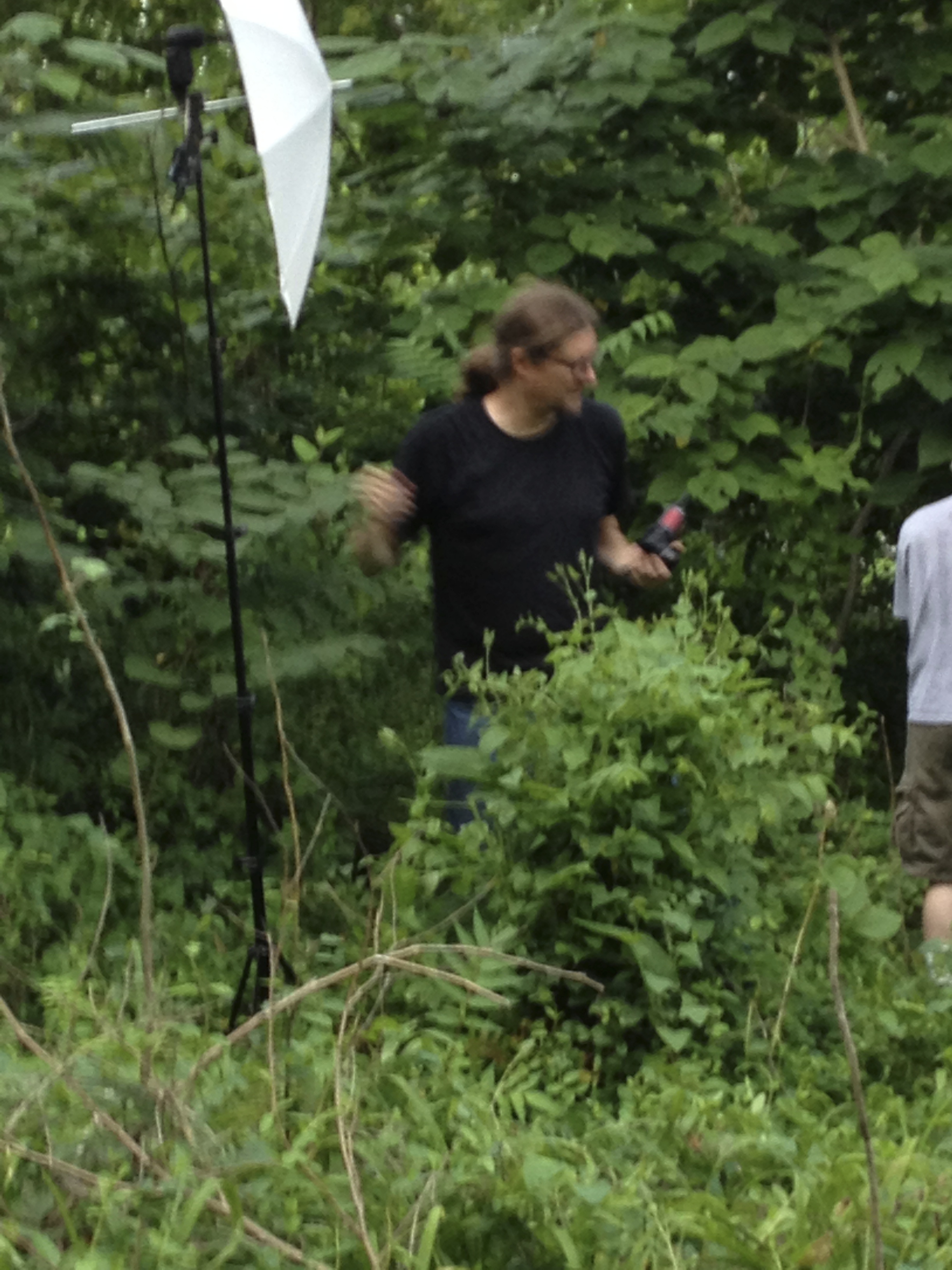
Here we see Kyle in rare jungle footage, as he prepares for his leading role in "Anacondonado IV."
Here we see Kyle in rare jungle footage, as he prepares for his leading role in “Anacondonado IV.”

Kyle specializes in journalistic photography, portraits, and fast improvisation. I’ve participated in one of his photography workshops, and he is extremely good at taking what’s available in a space and using it to great effect. He’s efficient as heck and carries around a positive attitude and sense of humor that is contagious.

So, we turned off of the road and the sight of a lush green hill dotted with stones, punctuated with columns and framed by mausoleums (mausoleii?) made us all squeal like teenaged Goth chicks at a 2 for 1 sale on black lace fingerless gloves.

LINDSAY: I don’t know, you guys, is this grave-y enough?

BOB: Is this grave-y enough?

I turned the car onto the least-beaten path, and then again, and within a minute or so, we were surrounded by Mid-Atlantic Jungle.

Memento Vitae.

On what must have once been brick platforms, rising to either side of the path, were clusters of rich green forest, and a vine-embraced tree that was twisted in the way trees will when their roots defy stone and their branches combat for light. It made a canopy around a granite memorial column from probably the late-Victorian era, and we said, “Yep, that’s it.”

You know you’re making risky art when you’re changing your clothes by the side of a car, using a window for a mirror and someone is offering you bug repellent.  The lantern I’d brought was deemed not period correct (I agreed, but it was the closest thing I could find), so Kyle made some magic happen and slid an electronic device up Kyra’s sleeve, and voila: the illusion of a period-currect flashlight.

Behind The Scenes shot of the shoot.
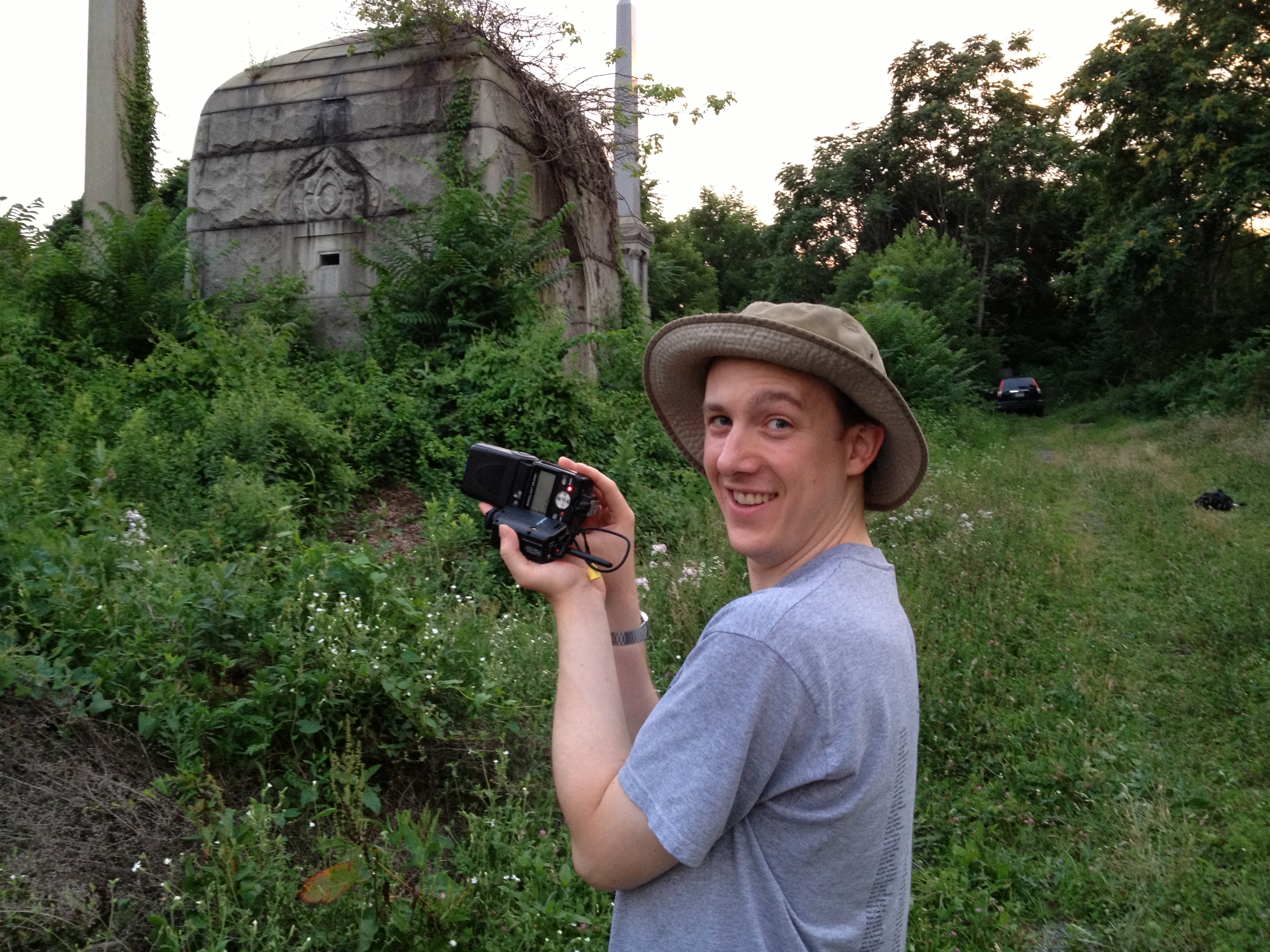
Liam Castellan, director, producer, and all-around git-er-done guy.

We played around the monuments for a while and Kyle took pictures, Liam was the Cheez-Itz powered voice activated light stand, and it was a lovely evening in the land of the dead.

and then we packed it up, and went home to brick boxes in which people live.

I don’t think there’s anything better than having good collaborators.  There’s a quote about writing, often attributed to Dorothy Parker, which goes, “I don’t like writing, I love having written.” The first draft, and second and third, are always a bear, a tiring process of grunt work, made worse because it’s lonely. But, when you get together with creative collaborators and actually do something with what you’ve written, and they bring their own ideas and resources to the project, that’s the real reason that I write.

"Make this mistake with me."
“Make this mistake with me.”

TL:DR; Another life peak experience. Coming soon: Real Photos!

We’re looking for theater artists.

We’re trying to find designers to work on Traveling Light. 

Here are the details.

Liam’s Sofa Cushion Fortress presents the Philadelphia premiere of  “Traveling Light” by Lindsay Harris Friel, directed by Liam Castellan.

Load-in is Monday, September 2, and performances are 9/6 through 9/14, in the Skybox at the Adrienne.

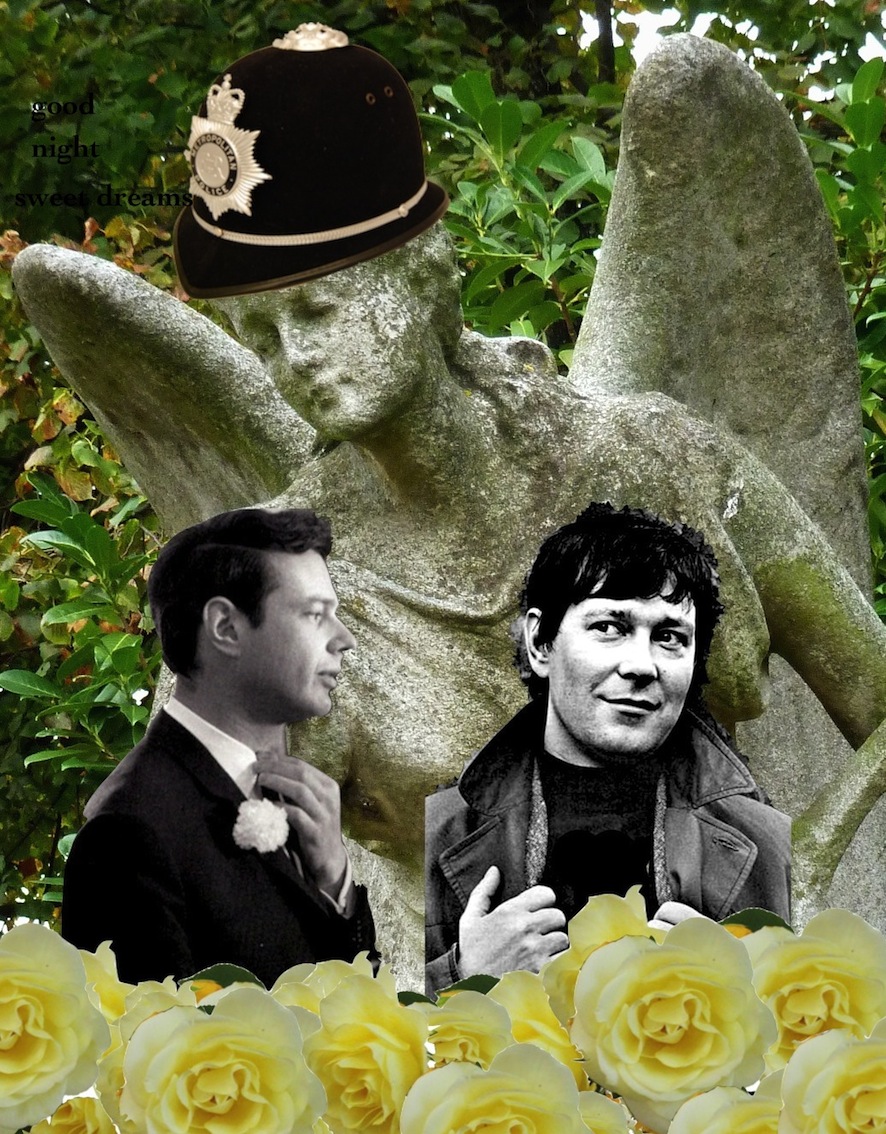
1967 London: the “Summer of Love”. Playwright Joe Orton confronts Beatles manager Brian Epstein late at night in a Jewish cemetery. They spar over big ideas and big secrets. When a policewoman and her male superior arrive, it could mean big trouble!

COSTUMES:
Looking for a costume designer for four costumes total.

SCENERY:
Looking for a designer to build and install a unit set.

Both positions pay a stipend.  Looking for designers based in the Philadelphia area (or with “local housing”).

Email liamcastellan@yahoo.com with resume/etc. and any questions.

JOIN US!

A Midsummer Night’s Dreamers

Traveling Light makes its Philadelphia premiere this September in the Philly Fringe.

Traveling Light 1st image  Once upon a time there was a young man who heard some really beautiful music. He’d dedicated his whole life to aesthetic pursuits, but when he went down into a dark cavern and heard the beat and the harmony, he knew he had to bring that beautiful music up out of the dark and polish it and present it to the whole world. This music became bigger and stronger and more beautiful, until finally it could move on its own, and it was too heavy for him to carry any more, and it threatened to break him.

At the same time, there was another young man, almost exactly the same age, who liked to tell stories. Unlike the first young man, he’d been surrounded by a lot of ugliness and anger for most of his life, and the best way for him to deal with it was to create stories in which tricksters gave the bad people the badness they created right back. He went to a school that taught all about beauty (strangely enough, the same school that the first young man attended), and the first time he tried to make something beautiful and strange, it was so strange that people got scared, and he was sent to prison. While he was in prison, he polished his process, and when he got out, he continued making things that were strange and odd and funny and sad, with a vengeance.

This was all at a time when the world was changing. It was easier to make your voice heard over miles and miles, and the world seemed to be getting smaller, and  people were starting to realize that maybe if they started treating each other as equals, kindly, amazing things could happen. But sometimes, even that was abused, because it’s awfully hard to get rid of things like greed and jealousy.

The first young man said to the second one, maybe this beautiful music I manage and your odd and strange stories could be put together to make something amazing. and the second young man said, I’ll see what I can do. so the writer went home and wrote a story, and brought it back to the music manager.

and the music manager said, this is too much. this is just too extreme, and rough, and unusual, and I don’t even know how to describe it.

and the storyteller said, but you’re just the same as this kind of story, you’re indescribable in the same way. you’re also that which can’t speak its name for fear of prosecution.

Later that summer, the storyteller came home, to find the person he expected to be waiting for him, waiting, as always, but this time with a hammer and a jealous rage, and by morning, the storyteller was dead.

and twenty-one days later, the music manager took too much medicine that he thought he needed, and the next morning, he was dead too.

the story teller kept a diary. so did the music manager. those diaries are kept secret, as diaries should be. but some things happened that summer, and some of the diaries’ pages are believed to be destroyed. and nobody knows why.

that summer was called “the summer of love.” which is an odd name for a summer in which there were a lot of fires and war and riots and protest. there were also a lot of warm, sexy nights where people broke rules and did what their hearts told them to do.

this isn’t a dissertation. it’s a play. less factual, more fun.

——————————————————————-

It feels weird to be promoting this play in Philadelphia, now, when I wrote it years ago. The production in Minneapolis, by Theatre Pro Rata, directed by Natalie Novacek, is still extremely close to my heart, and had a lot of magic in its site-specific production at Layman’s Cemetery.  Carin Bratlie and I still brainstorm and I still miss Minneapolis, the people I met there, and their commitment to making fun, brilliant theatre. After that production, I somersaulted straight into Temple’s MFA program, and it’s been hard to come up for air at all ever since.

I don’t want people to think this is the only play I’ve ever written, but it seems to be the one people like the most, and I’m deeply grateful that Liam Castellan said, “I am going to pick this play up and run with it.” and finally, this play gets to happen in my home town.

We have a cast. They’re beautiful. We’re still looking for designers and crafting press releases and planning photo shoots and so on and so forth. for now, I get to be so excited about it that I am forced to be experimental with capitalization.

Details to follow. Keep your eyes peeled.

Good things, small packages

I’m very happy to say that I’m part of the Philadelphia Installment of the One-Minute Play Festival. 

ompf-logo-2-copy  It’s exactly what you think: an evening of short plays, all of them one minute or less, a highly concentrated, haiku-esque dose of solid theatre.  Creator Dominic D’Andrea has been making this happen in cities around the country, and I’m pleased as a pig in mud to be included on the same bill as these playwrights and directors. Some of them are longtime friends, some I’ve admired from a distance, and some of them are people I’ve never met, and we’re all crunching ideas into delicious tasty cake pops of emotional substance. Or, you know, coal into diamonds. Your mileage may vary.

I have created this kind of super-short theatre before, and “short” never means “simple.” For several years I was a contributing playwright to Night of 1000 Plays, produced by The Brick Playhouse.  In that case, each performance piece was three minutes or less. Some of my favorite work came out of writing for N1K, especially Juliet Balcony, Let’s Call Him Matt, Not Without My Pumpkin, and Car and Driver.  Writing Car and Driver let me play with a vocal style to give a car a personality, which later became the voice of the Lotus in Phoebe and the Lotus.  So, I sort of knew what I was getting into when I started creating pieces to submit, and how they could help me in the future. It’s not that you’re creating a sketch: these are full, finished, stand-alone works. They exist best as a smaller piece of something big and diverse. and provide great opportunity for imagination, because your limitations are so severe.

So far, I have to say, writing a one-minute play is harder than writing a three-minute play. Basically, you get in, make meaning, and get out. Then remove the first and last ten seconds. Then condense, and condense, and condense. “Excuse me, but I need to buy a plant, can you help me?” has to become “Can you help me buy a plant?” which in turn has to become, “How much is the green thing?” or, “Please help me.”

Alternately, you just come up with the most concentrated dose of meaning you can think of. BAM.

So, anyway. Writing this kind of thing is fun, and it looks like the performances will be, too. They take place on Monday July 29th, Tuesday July 30th, and Wednesday July 31st at 8PM, at Interact Theatre Company, at The Adrienne Theater, 2030 Sansom Street, Philadelphia. Tickets are $20 and the significance is all-you-can-digest.

20,000 Leagues Under The Sea

YOU GUYS YOU GUYS YOU GUYS. This morning I discovered that, in one of my greatest childhood fears, and most enduring recurring nightmares, I am not alone. Other people also find the 20,000 Leagues Under The Sea Ride at Disneyworld terrifying, yet irresistibly attractive.

Image

Like schadenfreude, I’m sure the Germans have a word for that combined passive-aggressive force of terror and excitement which this (now nonexistent) ride causes, but I don’t know what it is. But, early this morning, celebrated genius and madman John Hodgman live-tweeted his experience watching an amateur video of the ride, sharing all the fascination and fear I had long thought was just a figment of my own insanity.

Sadly, I missed this live-tweet treat. I was asleep. I know, it’s really irresponsible for me not to stay awake all night hoping that a forty-something-year-old man will get all liquored up and describe the YouTube videos he watches from his lonely hotel room. Fortunately, his tweets are preserved for Internet posterity:

Now, with my oatmeal and coffee, while waiting for the air conditioner repair technician to come over and provide us with The Startup Special (maintenance check and cleaning, not a tasty beverage served with brunch for people too cheap for mimosas and too easily confused for bloody marys, although it’s a good idea and someone needs to get on that), I can sit here and relive all the Terrorfascination of my childhood.  AND SO CAN YOU.

This video is particularly perfect because I visited Disneyworld in 1980 at age ten (yes the math is easy and you can skip that), so this experience is almost exactly what I suffered. My brain was completely split on the issue. First of all, the film was part of my Dad’s childhood experience, not mine; he was the one who was jonesing hard for this ride.  The movie wasn’t part of my childhood, so I didn’t know what to expect, except that we were getting inside one of a flotilla of identical pointy submarines to experience a simulated threat. I knew there was a British guy with a beard, a pipe organ, strange machinery, and a giant squid, all of it underwater. This is pretty much all you need to know, true. But, being ten, my brain was right on the fence between “I know this is a manufactured illusion, and I can appreciate that,” and “I am buying this hook line and sinker I need a scuba tank NOW NOW NOW WHY ARE YOU TRYING TO DROWN ME, DAD, WHAT DID I DO THIS TIME?”

Then the former thought process overtook the latter. The fear of being miles below the ocean’s surface, in a metal can helmed by Paul Frees and en route to being squid food was far outweighed by another possibility:

Eyes like a doll's eyes. Just like Jaws.  Robot Fish.

Not only Robot Fish, but Robot Sharks, silently patrolling a graveyard of broken, sunken tall ships. With their barnacle-covered masts just barely visible in the darkness, of course it made me wonder what lurked below. More machinery, turning over and over in the watery darkness?

What if the pane of glass, against which my nose was inextricably pressed, were to crack?

I backed off a bit.

What if there were a leak? Had anyone gone over safety procedures with us? Where was the  steampunk stewardess with a nice clear Disney name badge explaining the proper use of oxygen masks in the event of cabin depressurization? If one of the windows broke, would the robot sharks get sucked in here, along with gallons and gallons of water? Or would we get sucked out? Would I end up trapped in the water under a ceiling of machinery, the sleeves of my shrinking wool sweater tangled in the mechanical tracks and arms? Would my last sight be the too-close face of dead robot fish eyes and teeth? Would I meet a watery grave in the arms of a faceless seaweed farmer? Or would I just be trapped under giant white molars of fiberglass shaped like glaciers?

This guy and the lady statue face from the Jungle Safari ride take turns in my nightmares.  My childhood fascination with Greek myths made me perk back up at the mention of Atlantis. As we came around a corner to meet an adorable little coven of mermaids, their pearlescent faces too cute to be anything but dolls’, I wondered what an actual bloated human corpse, trapped in their mechanism, would look like. By the time the squid tentacles wrapped over the windows, all I could think about was in what ways a human head would be destroyed by that kind of water pressure. Would it explode, or implode?

Fortunately, the ride isn’t even fifteen minutes long. My over-active imagination and I survived the trip. I still have recurring dreams about riding on Disney gondola rides and being pushed out of the boat, into the dark water, and sucked into the machinery below, as sober-faced statues stare me down.

Now that I think about it, I wasn’t ten when I took this tour. I was fourteen. That explains why I was more worried about what I couldn’t see than what I could. I remember that, on an earlier Disney World trip, when I was ten, the 20,000 Leagues Under The Sea Ride had been shut down for cleaning and maintenance. We rode The Skyway over the Magic Kingdom, looking down at the soggy neon landscape, as maintenance workers brushed and hosed rubber coral reefs in the November sunshine. My dad, for once, was silent, the opportunity to share pure fear with his children deferred.

The Walt Disney Company plans to shoot a new 20,000 Leagues movie in Australia. So, maybe within the next five years or so, my brother and I will get to relive our childhood fears on some new version of that ride. I hope this time they have actual seats, rather than those little metal stools that folded out of the wall, because our butts will be much less forgiving by that point. Until then, we’ll just have to satisfy us with loving tribute websites, like 20Kride.com and Lost Attraction Tribute, which not only share the fun of the ride experience, but the creepiness of the backstage.

Thank you, John Hodgman, for not only reminding me of my first grand mal anxiety attack, but helping me relive it, and helping me know that even if I am insane, I’m not the only one who has this recurring nightmare.

And I know, I haven’t posted anything in nearly six months. I have a good explanation, but that’s for another time.

Happy Birthday, David Bowie

Photo by Jean-Luc Orlin  David Bowie turns 66 today, and, true to form as a brilliant marketing person as well as an artist, he’s giving us all a birthday present. His new album is released today, with a new single, ‘Where Are We Now?’ with an accompanying video. The short film by Tony Oursler is as captivating as any of Mr. B’s other projects, a calm, pensive exploration of one’s place in the last 66 years.

He was born in 1947 (same year as my mom) into an England repairing itself from World War II. The tragedies of that time were so horrible it was believed that the human race could never, ever do anything so bad to its fellow creatures ever again. Of course, history has shown that humans have an amazing tendency to shoot themselves in the foot. Repeatedly. The video for ‘Where Are We Now?’ is crafted to show Mr. B’s diverse drives concerning his role as a pop artist in a world where disasters are quickly forgotten, covered by a fresh coat of paint and a pretty PR campaign.

The video opens with a shot of what appears to be a large, cut diamond, on a cluttered surface, at the center of a cold visual field. Most viewers will instantly believe this to be fake: glass paperweights and plastic tchotchkes like this sell everywhere from Tiffany’s to A.C. Moore. Later we’ll look at what the faceted jewel signifies and what it actually is. Don’t let me forget. (Cripes, hang onto your butt, because this could get more rambly than Quentin Tarantino’s famous speech from Sleep With Me about the homoerotic nature of Top Gun. But, the only person with a more calculated sense of image other than David Bowie outside of public office is Madonna, so no detail is in the frame by accident). The next shot is of a broken or disassembled frame without a picture. The glass is intact, and reflects a view of a street, with moving vehicles. It’s sort of a glass half empty/glass half full test: is this garbage, or is it a picture in and of itself? Or is it a symbol of two-dimensional art abandoned?

The point of view moves through a room, again with a cold visual field, cluttered with mismatched objects and evocative of abandonment or disaster. It finally settles on (again, ambivalently), what is either a pile of clutter or an arrangement of mismatched objects, like a still life or installation. The primary focus is on a screen, projected on which are street scenes in black and white, and a doll that appears to be a two-headed baby (which seems to be a not to Mr. Bowie’s embrace of circus freaks and space oddities, cuddly friendly ones). The faces are blank white pillows, on which the faces of Mr. Bowie and an unnamed woman are projected. Their faces are distorted by the projection, pulled tight, into barely-human masks.

The Brandenburg Gate by Thomas Wolf  As the song proceeds, the text of the lyrics is provided, bit by bit, complementing the rest of the visual experience. The song has the feel of a lullaby or a funeral song, dreamlike and peaceful but also somewhat disquieting, describing the experience of traveling in Berlin. The visual layout and pacing of the sung lyrics seems to be created specifically for this video to be watched online and compared with searches for the terms he uses. Of course, if you’re German, European, or any kind of a serious history student, the words are familiar. If you, like me, are 24 years younger than Mr. B and took American history instead of European, you might want some help from Google.

postcard, c. 1900  The song describes the experience of being in Potsdamer Platz, one of the busiest locations in Berlin, watching the crowd go by, on the Nürnbergerstraße, which is a popular shopping and tourist destination, looking at the KaDeWe, an elegant department store, and crossing the Böse Brücke. Today, these would be places where lots of commercial and tourist activity occurs, where supply and demand glitter and groove. However, the history of these locations is heart-stopping.

On November 9, 1989, the Böse Brücke was the first crossing point when the Berlin Wall fell, reuniting East and West Germany, completely changing the consciousness of the nation and the life of every German. The KaDeWe, or Kaufhaus des Westens, is the second largest department store in Europe. It has a greenhouse-covered roof housing a winter garden and restaurant, and anchors a boulevard of designer boutiques to rival any in Los Angeles. The business was founded in 1905, but the Nazis obviously decided to remove the mostly-Jewish management. In 1943 the building was nearly destroyed by Allied bombing, most notably when a plane crashed into the building. Potsdamer Platz itself was divided by the Berlin Wall and turned into a wasteland for much of the Cold War Era. Prior to that, its status as an important gathering place and trading post is recorded as far back as 1685, which made it a high-priority location for Nazi propaganda and offices.

Essentially, Bowie is pointing out that places of ancient plenty and pain are prettied up for profit, and asking “where are we now?” Have we improved as a society, or have we just given history a PR campaign? What does it mean to take places where people struggled and died and turn them into shopping malls?

Minors mining in Sierra Leone.  Let’s go back to the is-it-or-isn’t-it-real diamond for a second. Think about what it actually is, and what it stands for. If it were real, a lot of people would have died to get it out of the earth, transport and protect it. It is probably a glass or plastic imitation of the idea of a giant flawless diamond, manufactured by the thousands in a factory somewhere in China. Think about how it stands out in contrast to the rest of the visual field here: barren gray versus “ooh shiny.”  I don’t know about you, but, unfortunately, I live in a world where thirteen-year-olds fight over Louis Vuitton handbags. Not because they earn that kind of money or save up from a paper route or lemonade stand, but because their priorities (and those of their families) have become so wrecked by poor educations and too much advertising that they honestly believe that buying the latest fashion accessory is more important than anything else.

Marissa Orton via Creative Commons  Never mind that this fashion accessory may have been made by a child who was paid maybe five cents a day to make it. Never mind that it was made in a factory in a country with such poor environmental protections that, all together, shopping in the Potsdamer Platz at the KaDeWe can set off a domino effect of money changing hands that results in the kind of widespread all-around badness that can still be as devastating as what happened in Berlin in World War II, just not all at the same time. So, not only are we sweeping tragedy under a very pretty rug, we’re also building another tragedy on top of it.

But, OMG I HAVE TO BUY THE LATEST SHINY TRINKET SO I CAN BE COOL LIKE KIM KARDASHIAN.

David Bowie and Sound Engineer Eduard Meyer in the Meistersaal Berlin,  Oursler’s film places Bowie and Berlin together by showing footage from when Bowie lived in Berlin. This city and experience figured prominently in Bowie’s life, allowing him a place to get clean from drug use, and helping him create the albums Low, Heroes and Lodger. This film provides an opportunity for younger fans to get to know him, with its (aforementioned) multimedia-friendliness. It also allows older fans to travel down memory lane, back to when “Heroes” and “Boys Keep Swinging” really meant something. The lyrics say that he is in a “Dschungel,” or jungle; if you only hear this, it sounds almost exactly like “jungle” is the sung word. “Dschungel” is one of only three word in German that can be masculine, feminine, or gender-neutral. Bowie kicked down a lot of walls for men who liked to wear dresses and makeup, as well as women who liked to wear trousers and suspenders. In this song he isn’t the buoyant alien, or the wild rocker: he’s “a man lost in time, walking the dead,” (sung with the image of someone walking with a dog). The song never refers to the glitz of the shopping arcades, it could take place at any time in history. it’s a reflective story of a traveler walking with ghosts. Whether those ghosts are personal, political, or spiritual is unknown.

The climax of the song is the most universal part, evoking the love-conquers-all message of “Heroes,” with the simplicity of “Everyone Says Hi;”
“as long as there’s sun…
as long as there’s rain…
as long as there’s fire…
as long as there’s me…
as long as there’s you…”
The narrative states that as long as there is human companionship and kindness in balance with nature (sun, rain, fire), everything will be all right.

Disasters are on everyone’s mind this winter, as if they are ever far away. Berlin is a place of agony, where some of the worst of the human race’s offenses occurred. However, for Mr. Bowie, it is also a place of escape, where he created some of his best work and when he got clean. It’s a place of tragedy, commerce, and hope. Coming back to the diamond, we need to think about things (Berlin, Bowie, disasters, ourselves) as a faceted, like a jewel.

But, just who is David Bowie to pass judgment on the human race in the last 66 years of history?

When the images on the screen in the assemblage start to become most personal- point of view shots which take over the entire visual field, the film steps back to include Mr. B himself, looking at the multimedia art installation. Colorful objects are in the foreground, and a dog walks by, wagging its tail. Bowie is in the role of artist here. Despite the bits of warmth in the frame (the red text on the shopping bag, the ginger fur on the dog) he is in pain, clutching a notebook and pen- he’s at work, and his work hurts.

Again, nothing here is by accident. Bags with text saying “Thank you for shopping here!” can be found around the world and clutter every nation. The message, “Thank you for shopping” is not unlike George W. Bush’s message to the American people after 9/11.  Bowie’s a businessman, an entertainer: he provides product to consumers. He’s not exempt from any anti-consumerist message, and his hands are no cleaner than anyone else’s.  There’s another chunk of text in the shot that’s telling us something: Bowie’s t-shirt says, m/s Song of Norway.

So, just to recap:

he’s wearing a shirt
advertising a cruise ship (cruises being the easiest and most homogenized way to travel)
named after a Hollywood musical (starring Florence Henderson before she became Mrs. Brady)

(I’m not making this up)

named after an operetta (for people who find opera too much to handle)
based on a play
about composer Edvard Grieg, and his drive to create music that contributed positively and meaningfully to the national identity of his homeland.

Which really has to be a nod to how a musician creates something and it travels through time like words in a game of whisper down the lane, and eventually you have no way of knowing how you will be remembered or what your impact will be. You can go nearly mad writing “In The Hall Of The Mountain King,” and two hundred years later your music is on Bugs Bunny cartoons and your lasting tribute is a mode of travel for the terminally lazy.

(Oh, snap, I said that. I guess nobody’s giving me free cruise tickets now.)

because $3k stripey shirts and $20K pinstripe suits make you want to wrestle on the floor.   What? Maybe Bowie always wears his cruise ship t-shirts when he’s just hanging out in the studio? Yeah. Right. The guy did a fashion ad campaign for Gucci, for God’s sake. I don’t think he leaves the house without four hours of planning and several drafts.

However, the last place where we see Bowie is not standing back against the wall with marketing copy. We see him as one of the faces on the conjoined-twin baby doll. After the woman removes her face from the projection, he steps back, but hesitates for a few seconds, as if reluctant to leave. It is as if Mr. Bowie is more comfortable being part of the image he creates than a person in real life.

Mr. B, like his own video, and the fake diamond at the beginning, is multifaceted and not without flaw. But, he’s pretty when the light hits him right, he’s here to entertain you and make you think. and, like a real diamond, he endures.

Yay, timely critical analysis of a short film, whoooohoooo! I gotta go read Ubu Roi now.

I love new stuff

I just got my new recording mics and I decided to make a video of  the uncasing. Enjoy.

The music that you are hearing comes fro m the Mellotron Mk2 rhythm tapes via the G-Force M-Tron Pro VST plug in. There were basically a bank of tapes activated by the keys on the left hand manual. There are a lot of cheesy rhythms and fills to enjoy and they are being played by an actual band recorded at IBC studios in England circa 1964. So it was me and them and it..

Yes, he did say the guy playing was his son-in-law. They were the financiers of the instrument and Eric provided the musicians for the instrument recordings.

Cut Me Some Slack

Okay, so here’s my quick review of the giant ham and cheese sandwich that is the Nirvana-McCartney shebang last night. which I did not see until 6:30 this morning, which was this  recording, while making coffee.

0:04: Dave Grohl: I am totally gonna do that Namaste bow I learned from the hot chicks in yoga class. Yoga chicks love that shit.
0:10: Krist Novoselic: It’s cool, Sir Paul. Half the room has no idea who you are either.
0:21: Pat Smear: Everybody thinks I’m Fred Armisen.
0:22: Paul McCartney: I Am Gowing To Speaak In My Sir Pawl Vowice So Evaryone Knoows I Hawve Bean Knighted. And Sow I Wawrm Up My Vowcal Cowrds Awnd Down’t Crawk Like I Did At The Olympics. We’re Gowing To Jawm Owt This Rawk Hit.
0:26: Krist Novoselic: Okay, so I let my daughter pick out my clothes. At least I’m not wearing a rug that looks like a refugee duck from the BP disaster.

My thoughts about the music: When Novoselic said “It’s gonna sound like Scentless Apprentice and Helter Skelter,” he was right, but I think it sounded more like Come Together. Again, this isn’t the finest recording in the world, it’s pretty good, all things considered, and I hadn’t had my coffee yet, and I thought, of course it’s good. It goes on for 60 seconds too long, but of course it’s good. Your lead guitarist has been playing professionally for over half a century and basically is one of the inventors of the genre, your drummer has been playing in every kind of band since he was a teenager, your bass player has been hanging out for the last 20 years playing music for other people’s bands and saying, “fuck the system,” they’re gonna go through the standard book of basic rock riffs and throw all of them at the audience. I don’t know why they had to throw them all at the same time, they could have afforded to back off a little bit, go for finesse instead of bombast, but I’m sure Sir Paul could only give them two hours (including the performance night).

I’m also dying to know what kind of guitar Sir Paul’s playing here.

You know what would not have sucked? All things considered, if they had done this, which has no relation to a hurricane, but it sure would have been fun to listen to:

I just hope this means some more people get heat and electricity and food and clothes and stuff, who need it.

Donate to the Robin Hood Relief Fund. 

Blogging here has been thin, the semester has been thick.  Right now I’m up to my nose in a work in progress and up against a deadline, but I promise some actual content after it’s all over but the shouting.

12 strings and things

Back in the early 60’s a small beat combo from Liverpool England invaded our shores. With their (at the time) outrageous haircuts and cute looks, they took America by storm. On the interesting things that most musicians noticed is what kind of guitars they used.

They didn’t use the usual Gibson or Fenders that so many of the other American groups used. They were using guitars made by Hofner, Gretsch, and Rickenbacker. After their initial appearance on Ed Sullivan and later on, the movie screens, The Beatles literally started a whole new guitar craze and a new sound. That guitar George was playing looked like a regular guitar but it had 12 strings. Yes, Rickenbacker provided George with their 2nd 12 string electric. One person who went to see “A Hard Day’s Night” was a musician named Jim McGuinn, he had already teamed up with David Crosby, Gene Clark, Chris Hillman,and Michael Clarke and decided that the 12 string electric was the new sound and immediately acquired one.

Now I have had played a lot of guitars over the years. I have played Gibsons, Fenders, Mosrites, Tesicos, Danelectros, and Rickenbackers. Out of all of them I could never bond with Rickenbacker.

Rics were not always mega-expensive on the used market. Back in the 80’s $500 cash could get you a 360/12. A lot of it has to do with supply and demand as well as trends in music. I remember music stores had Vox amps selling for a song becuase everybody wanted to be Eddie Van Halen or Heavy Metal. Well, at least in Northeast Philly anyway.

Yes, the 60’s and its music was reserved to record geeks and people who listened to alternative radio or “college rock”. Yes, Tom Petty made good use of Rics and old Vox amps, as did Paul Weller of The Jam

but they were not what was selling. REM was starting to gain some notoriety and Peter Buck was playing a Ric as was Marty Wilson-Piper of The Church   but here in the NE Philly it was BC Rich, Kramer, and Les Pauls.

Over the years I have ended up owning three Rickenbackers. The first was an off-white 330/12 with black hardware which I bought at Zaph’s Music in Olney. After a month with it I really didn’t like the look of it, too New Wavey, so I took it back to and straight traded for a used 360/12 in fire glow.

Now that was more like it, I now had the same guitar Roger McGuinn started out with before his was stolen. I also acquired a 330/6 in fire glow. So I now had all my bases covered. But there seemed to be a certain something that was still bothering me.

Well, the first thing that was a pain was changing the strings and keeping the thing in tune. The other thing was that Roger McGuinn finger picked and I didn’t, and that I have Truckasaurus sized hands. Combined with the narrow neck of a Rickenbacker 360/12, not a good match.

After owning two Rickenbackers 12-strings I have come to the conclusion that they are not the guitar for me. I have played other 12-strings that in a blind taste test you couldn’t tell the difference. A lot of the Ric mystique is due to the Beatles and the Byrds. If the Beatles played on Ed Sullivan with Teles and Strats who knows what might have happened.

For those of you that have them, enjoy them.

And I will be the first to say that I salute the fact that they are the only major American guitar company that builds their guitars exclusively in the USA. But…

I personally do not like:
-The price (unless you use it as your main guitar, or your name is Roger McGuinn I still find the price a little on the steep side. Even used it seems the prices went up. Back in the late 80’s you can get a used 360/12 for about $600 in great condition)

-The neck on the 330 or 360/12 is too narrow.

-the unstable tuning (but most electric 12-strings suffer from this. Nature of the beast)

-the bridge (6-string saddle? really? If you want a 12-string bridge (which should be on there anyway) it will cost you $125.

-the ridiculous “R” tailpiece

-the over abundance of laquor on the fret board. It feels like playing peanut butter.

-Unless you play the 12-string throughout the gig it’s another piece of gear that can stay home.

Well, that was my little post on the Rickenbacker 12-string. It’s just my opinion


Summer 2012 Review

"No, really, I have ideas. I didn't say they were good ones." Recently I was introduced to the Tumblr, whatshouldwecallplaywrights.tumblr.com, which made me laugh so hard that my core muscles ached, and I have to thank its creators for giving me a workout.  If you are not a playwright, you’ll find it funny, at least for the pop-culture references. if you are any kind of a writer, especially a playwright, you will find it painfully funny, with an emphasis on pain.

As I was dragged into its web, my experience went from gleeful to sad, and then I moped around like a loser with my chin in my chest. The Tumblr talks about things like “when i have a reading and…” or “when I have an audition and…” or “when I have rehearsal, and…” and I haven’t had the “actively making theater with other live human beings in the same room” experience for a long time.

My dramaturgs.  Confession: I have spent my summer chin-deep in new work in progress. This always sounds so exciting, like I’m conjuring glowing dancing fairies out of the palm of my hand while hapsichord music plays in the background. In reality (I have no talent for making animated gifs, so I won’t submit this to them), I have been typing, scribbling, talking to myself, and having fights with junk food. I read scenes out loud to the dogs.  Squeaky was particularly excited about the scene that involved knocking on a door.

Then, my inner smart playwright said, that’s it, I’m turning the car around. People won’t know that you write plays that are good and so on and so forth unless you have a public writing platform type thing, so do what you know you need to do. Back to the blog with you, Nessie.

Hello. I’m back in the game.

Other than the work-in-progress (It’s fine. I’ll let you know when it wants to be known about), here are some other things that I enjoyed this summer.
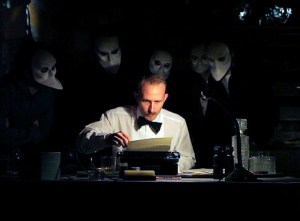
  Sleep No More. I was introduced to this by my dear friend Jennifer, who organized a trip for a bunch of us to go up to New York to see it. I had attended immersive theater experiences before, such as Pig Iron’s Pay Up, and have a deep, abiding love for site-specific theatre. Creating Mixed Drinks at O’Neal’s Pub in 2003 was one of my life peak experiences. I love being inspired by a space to create a piece that works in it, and I love complicated relationships between artists and audience. Sleep No More does not disappoint in any way, shape or form.  More than that, it gets under your skin and becomes something you can’t stop thinking about. When you meet other people who have seen it, it’s like being members of the same secret religion, and you curtail yourself off to talk in hushed tones, “Did you…?” It’s a theater experience that is incredibly real, changes based on the audience, and makes you re-think about how you exist in space and power relationships with others.

All this praise being said, I feel like I did Sleep No More wrong. I followed all the rules, particularly the most stern commandment, “Fortune favors the bold,” but I seemed to always be walking into a room just as a pivotal scene was ending and the actors were leaving. Or I would find a room where a character was having a private moment outside of the main plot. The experience I had was beautiful, inspiring, intricately woven, and emotionally intense, but afterwards I found out that one of the people in our group had managed to follow one of the actors like a hawk through the entire show, and had gotten a full, cohesive plot out of her experience that differed completely from mine.

This guy was as creepy as he was hot.  If I had to trade that for the things I did see, I wouldn’t. I found a mirror in a bedroom that reflected back everything in the room, except for me standing in front of it. I found spells scratched into the bottom of a drawer and read patient records on hospital bedstands.  I found a room plastered from floor to ceiling with pictures of birds. I never found the apothecary’s “pills” that everyone talks about.   I witnessed passionate, acrobatic scenes between all the side characters with their own secret stories, but I didn’t see anything involving the power couple until the banquet scene. It whets my appetite to go back, find what I missed, and learn more about how to create this kind of theatre.

Unfortunately, for someone like me, it is expensive. By the time I paid for the ticket, handling fee and transportation, I had spent myself dry for the week. I might end up turning tricks to pay for my Sleep No More habit.

  The Starlux. Vince and I don’t get out much when it’s not one of his gigs, so a long weekend in Wildwood was a big deal for us.  Vince used to spend his childhood summers there, so he was good at navigating, and I pretty much just rode along.  If you want the simple, relaxed Jersey Shore experience, with a certain amount of quiet and a certain amount of excitement, The Starlux is your best bet. It’s two blocks from the boardwalk, near the convention center, so there’s just enough convenience if Morey’s Piers and the boardwalk bustle are your thing, and just enough distance if you want quiet.  Separate from the main building are two lovely remodeled Airstream trailers, and we stayed in the one pictured here.  I fell in love with it very quickly.

Pros: A deck you share with one other trailer, with tables and a grill. With the air conditioner, it’s quiet enough that you will never hear the traffic (unless a Really Loud Motorcycle goes by, and that was infrequent).  The decor is pretty, with clean cool colors and sweeping lines reminiscent of the movie Sleeper, it’s very comfortable, and the mini-fridge and microwave make everything very convenient. The service at the Starlux is outstanding. Everyone is remarkably, genuinely friendly and does everything they can to make your stay pleasant.

Cons: If you are six foot four or taller, you may want to get one of their regular rooms or a suite instead. Vince fit inside, but didn’t stand up much. Had I been as, shall we say, girthsome, as I was in 98 or so, this would not have been a fun time. We were at close enough quarters that this would just be very uncomfortable for people who aren’t happy with seeing each other naked or hearing each other fart.  That’s the Airstream experience, they’re small. Get with it.

We spent most of our time relaxing in their pool, eating well, and working our way through Juan Pablo’s margarita menu. The Starlux also has complimentary bicycles to borrow, so we were able to get in a few local bike rides. Also, I fell from 100 feet up in the air.  I can prove it.  I recommend this experience, mostly because it’s good to be comfortable with the feeling that you have when everything you think makes sense is so far away that it no longer makes sense, and you think, “Okay, so this is how I’m going to die.”  (And then, of course, you don’t die, but it doesn’t seem like it will be that way at the time.) Also, the view of the ocean is stunning and humbling.

Damn right it's totally overgrown.  Gardening. I’m not much of a gardener. I go to Linvilla Orchards, I buy plants, I put their roots in the soil, and then I try to keep them from dying.  My only goal is to make a garden that looks like the complete and total antithesis of  all the neatly planted sterile gardens in our neighborhood. If it looks like Willy Wonka suddenly went from candy to plants, as far as I’m concerned, achievement unlocked.*

If you have ever tasted the difference between a home-grown, well-loved tomato, and the kind you buy in supermarkets, you can get a little nuts trying to make his happen at home. We have some tomato plants (some Better Boy and some Brandywine, which are an Amish heirloom variety), enough basil to make pesto occasionally,  a rose bush, and we have a lot of morning glories. The rose bush was nearly dead this past spring, but frequent watering and some compost has made it come back with a vengeance. One tomato, so far, has grown to the point of being red and ready to eat. The rest are taking their time. Daily watering gives us a meditative ritual for the day, it’s very peaceful and it feels productive.  Pulling weeds lets me get out a lot of aggression. And, speaking of getting out aggression…

Zombies, Run!  Zombies, Run! Six to Start briefly offered this game for $1.99 for one day only early this summer. William Mize recommended it, and I thought, if this gets me moving, it’s worth its usual $8 price tag.  It is a blast. The notion is that you go for a run, and the app does usual running record-keeping things that you want, such as pace and distance, but it also integrates a story with your music playlist. So, you’re not just running (or walking really fast, in my case). You are Runner 5, on a mission to get more supplies and food, unraveling a mystery as to what caused this post-apocalyptic adventure, and avoiding traveling packs of hungry zombies. So, as you run (or walk or cycle or whatever it is you do), not only does it switch between messages from the characters and songs in your playlist, but it lets you know when you’ve picked up useful items, like tinned food, a sports bra, or 9 millimeter bullets.  It also lets you know when a random zombie horde has been detected, and how far away they are.

One day, Squeaky and I were on a mission, and the game warned me that a zombie horde was right behind us, just as This Way To the Egress’ “Delicious Cabaret” spun up.  In the interest of avoiding traffic, I made a sharp turn down an alley we’d never taken, and sped up. Just as I thought, “I can’t do this,” not one but two big guard dogs decided to half-hop their fences, snarling and barking like I had pockets full of steak, that I’d stolen from their moms. I took off like a rocket. Squeaky was not amused.

So, yeah, it gets pretty real. This game will make you move. This past spring I was able to go for 40 minute walks at a clip, at a speed of about 2mph. Now I’m walking for 75 minutes at a clip at a speed of between 4 and 5 mph. My self-confidence and endurance have increased, and I feel better.

  The sad ending to my summer: On the same day that all my reading lists for next semester arrived, Amazon.com pronounced my Kindle dead.  Since it’s out of warranty, they  offered me a discounted, refurbished Kindle with “sponsored screensavers and supported content.”

So, basically, the Kindle died, and they offered to sell me a (refurbished) means to look at their advertising. If I’m paying for it, shouldn’t it be ad-free? If I’m looking at their ads, how can they charge me?  And if they can sell me a refurbished Kindle, why can’t they just refurbish my Kindle?

All I know is that I have 23 plays to read. If I have to read them on a backlit screen, that’s not good. Looks like I’m expanding my paper library this year, or I’m buying a new Kindle.  Bastards.

I’m less than a week away from a new semester in Temple’s MFA program, Vince’s band has gigs coming up, and the mint is knee-high, so please send bourbon.

————————

*This should explain the presence of Gardenbike, our trellis for morning glories, daylilies and mint. I thought it was a Frankenbike. I was wrong. It’s a Gardenbike.

Website Powered by WordPress.com.

Up ↑