we’ll find a place where there’s room to grow

Paul Williams wins a Grammy in 2014
Paul Williams wins a Grammy in 2014 for his collaboration on Daft Punk’s Random Access Memories. Photo by Allen J Schaben, Los Angeles

Before you think this has turned into a Paul Williams Stalker Blog, let me give you a little bit of background. Matt Casarino (friend, playwright, singer-songwriter, performer and half of the band HOT BREAKFAST!) and I have been discussing the Paul Williams documentary, Still Alive.

It stuck in our craw, collectively, as you might say. Were this a dog park, the documentary would be that weird tree root sticking up out of the beaten earth that we both kept sniffing, chewing, and trying to pull out, before realizing it was stuck to something much more insidious.

As dogs will, we are compelled to keep gnawing and pulling at that tree root until it sticks up out of the ground, and let the sun and rain hit it, until it grows leaves.

I think what’s frustrating both of us is that Kessler had the opportunity to interview Paul Williams, a person who tapped into the collective unconscious and spun out some amazing songs, and he dropped it. Matt and I both wish we could get a Google Hangout interview with Williams, to ask the really important questions (just how sleazy were the infamous El Sleezo dancing girls?) and just listen and let the man talk, for crying out loud.  What’s the science of his songwriting? What’s the process? True, there’s no specific formula to make something that tugs at your emotions, but Williams’ decades of work is close to Joseph Campbell’s decades of study of myth.

Matt Casarino on stage at The Baby Grand, Wilmington, DE

Initially, when I saw the movie and it bothered me, I started to write an e-mail to Matt about it. Matt knows the science of what makes pop songs and stories engaging, so I wanted to know his thoughts about the movie. Then I really got on my high horse and posted my rant publicly. Matt wrote me back, and was kind enough to allow me to post his continuation of the conversation here.

Both of us feel like this movie misses a point. Matt showed me that it hits another, very interesting mark.


Without further ado: this just in from Casarino.

————————————————————————-

The first 45 minutes of Still Alive are maddening. Frustrating as all get-out.

I understand documentaries can be as much about the filmmaker as the subject – whether or not they’re seen on-camera, the director/editor is the one shaping the narrative into the story they want us to see. But while a little personal context is fine, good LORD, man, you’ve got one of the most interesting fellows in the world in front of you, and you’re talking about yourself? Shut up, step aside, and let Williams talk.

My frustration reached its apex during the Vegas scene. After a few awkward shots of Paul’s wife, we see shots of her repeatedly interrupting the band rehearsal to ask the musicians how many comps they want as an annoyed Williams looks on. I turned to Jill and said “this is bullshit. It’s a cheap shot. Kessler is deceptively editing the film to make her look intrusive.” This was followed by Kessler’s v/o, as he opines that Williams is clearly annoyed that his wife is ruining this trip.

That’s when it hit me – I’ve been duped. Kessler isn’t clueless. It’s not just this scene that’s unfairly edited – it’s the whole movie. He’s doing this on purpose. He’s painting himself as a dopey, gooey-eyed fan, and purposefully leaving in all the shots “normal” documentaries leave out – the awkward and uncomfortable confrontations, the sideways glances given to increasingly intrusive cameras. He’s going behind the scenes of his own movie.

And with this method, he ends up showing us a side of Paul we otherwise never would have seen.

He could have given us a sitting-on-a-couch documentary, in which Paul takes us through his life, his various projects, his process, his highs & lows, all that stuff. That would have been very satisfying, honestly, because Paul is a fascinating man and has spent decades learning how to charm the camera. But we wouldn’t know Paul like we do now. We wouldn’t see the very real, often deeply uncomfortable moments when Paul is just barely too polite to tell Steve to go eat a handful of crap. We wouldn’t see an exhausted Paul telling Steve he’s all “Paul Williamsed out,” or telling Steve his questions are condescending and insulting. Those are real, honest moments, and very telling.

And they never would have worked in a “normal” documentary. They would have been jarring, making Paul come off as irritable, unpleasant, ungrateful. But here, we get it. We cannot believe this drip is botching his Paul Williams documentary, a movie he’s lucky to be making. When Paul’s values overtake his courtesy and he incredulously calls out Steve for being shitty, we’re on his side. It’s a great moment, albeit terrifically hard to watch. But if Steve were “invisible,” if the movie was more of a talking head documentary, that moment would make Paul appear irritable and combative. But because we’re as exasperated as Williams, we see a man determined to be present, to accept his past without regretting it. Paul’s not telling us how he feels – he’s showing us. Remarkable.

And Steve takes the hit. He lets himself be comically obtuse, mistaking Paul’s obvious sarcasm for an actual invitation. He lets Williams and his wife glare at Kessler and the camera with a sort of polite contempt. He’s a simpering wuss in the Phillipines, whining about the food and terrorists. He asks jerky questions that seem designed not to provoke answers, but to make Williams feel bad. Christ, he even dresses like a drip, with his oversized, droopy t-shirts, wrinkled pants, and stooped posture. Doesn’t he know he’s in a movie?

But by being the bad guy, he lets Williams be the good guy. That incredible moment at the end, when Williams watches a video of his coked-up 1983 persona with horror, absolute disgust, and embarrassment? That probably couldn’t have happened in a “normal” documentary. In this one, where the jerky filmmaker has been pushing for this moment for years and Williams has been resisting it, it becomes the entire point. It reveals the soul of Paul Williams.

Now, this revelation doesn’t mean I loved the movie. It’s still kind of hacky. Kessler lays it on way too thick, especially in his v/o that opens the movie, when he tells us how much Paul meant to him as a child. He overplays his hand, becoming so unlikable that the movie itself turns off-putting when it should be riveting. And he can’t resist unnecessary, gratuitous intrusions, like the campy clip from The Karen Carpenter Story. Even if his indulgence is a put-on, it’s still indulgence, and often maddening.

Paul Williams performing in Brian diploma's movie, Phantom of the Paradise.
Do you have any idea how hard it is to find a picture of Paul Williams playing a piano? Here, he’s at least got his hands on one, in Brian de Palma’s film Phantom of the Paradise.


Worst of all, the doc really doesn’t spend enough time on Williams’ extraordinary life. I get that Paul isn’t interested in telling old war stories, but there are some important questions that need to be asked. Who first noticed that he was a good songwriter? What movies mean something to him? What songs mean something to him? Who else does he admire? What was it like filming Phantom of the Paradise and The Muppet Show? How did he get sober, and how does he stay that way? What of his family, his children? The portrait of Paul Williams is incomplete without these questions answered. I suspect the middle ground between the vérité doc we got and the This-is-Your-Life doc we wanted is amazing.

But I still like the movie. I find Williams more fascinating, and wonderful, than ever. I want to be his friend, his confidant. And you know what? Now I don’t want to know certain things. I don’t want to know the lurid details of his drug habit. I don’t want to know his songwriting process. I don’t want to know how he channels sadness and depression into his work.

Well – I do want to know those things, but now I don’t think they’re any of my business. Now that I’ve seen Still Alive, I’d rather give him a little space, let him think about his next golf game and where he might want to take his family on vacation.

If I were writing soundbites, I’d say something like “Still Alive isn’t the Paul Williams biography you want, but it’s the one you need.” Thank Cthulhu I’m not a soundbite writer, because that makes me want to stab myself in the nipple. Instead, I’ll say this: I’m glad I saw Still Alive. I like this Paul Williams – a wonderful old guy who’s been through hell (and heaven) and still performs to make a living while helping thousands of people get and stay sober, a guy who’s lost more than he’s won but is happy with what he has. I’d still like to smack Steve Kessler on the back of the head for all the opportunities he missed, but I’d also like to thank him for letting me meet the real Paul.

————————————————————————————————-

It’s very true that Still Alive inverts traditional documentary conventions, to make us rethink privacy, loneliness and intimacy, particularly when those things are pushed against fame.  I’m grateful to have friends like Matt, with whom I can have these conversations.

You’ve almost convinced me I’m real

Paul Williams accepting the Academy Award for the song "Evergreen."
Paul Williams accepting the Academy Award for the song “Evergreen.”

Last night we watched the documentary, Paul Williams Still Alive. It was okay, but problematic. It might be interestingly problematic. Stick with this, because there is a point. I promise.

Basically, this guy, Stephen Kessler, was amazed to find out that award-winning, chart-topping soft-rock songwriter and television personality Paul Williams was not dead. In his joy and amazement, he set out to make a documentary about his childhood hero, hoping that maybe it would culminate in the two of them having a sleepover and staying up all night watching old tv clips from his many appearances and swapping tales of 70’s celebrity wacky times. Probably sitting in a pillow fort, wearing their pajamas and drinking Kool-Aid.

Result: the documentarian becomes the documented, and the experiment in narcicissm becomes really freaking tragic. It’s worth watching, if you want to see how what could be a very good documentary can go totally tits up.

This movie’s most annoying attribute is not Kessler’s strained relationship with Williams’ wife, the shaky filming, or the fact that Williams knows how run an interview and  how to direct a documentary better than this guy. It’s that not once does he touch on Paul Williams’ songwriting process.

Kermit The Frog and Paul Williams
Kessler does not spend any time discussing Williams’ collaborations with The Muppets. Unforgivable.

Kessler concentrates on the fame, tv appearances, booze, drugs, and sobriety, all the things about which Williams doesn’t want to talk, what should be the painful third act of your documentary, a part of it, not the end goal or sum and substance. We see Williams touch a keyboard once in the entire film (other than archival footage), and then only for a second. Paul Williams is now the president of ASCAP, and I can’t imagine a better advocate for the rights of songwriters. Although I have to admit I’d love to hear a discussion between him and Jonathan Coulton about songwriters’ rights in a mixed media world. I think Coulton’s experience with audience relationships and the Internet would be interestingly balanced by Williams’ decades in TV, film, and recording.

Kessler totally missed the fact that when you hear a Paul Williams song, you know it’s his, even if you don’t know the title, and haven’t been told anything about it. He has a particular style, once stamped on a song, which pulls the listener in, and then turns just as soon as a comfort level is established. He has an aural relationship with exposition, conflict, escalation and resolution which makes the listener always want a little bit more.

Kessler’s documentary is watchable, and shows us an intimate and painful side of a guy who has made a lot of people happy for many years (particularly in the Phillipines).  But it doesn’t show Williams’ productivity, never asked once how he worked on music while getting clean, or how he works on music now. THIS IS REALLY IMPORTANT STUFF. This is the kind of thing that helps artists and listeners and ARGH ARGH ARGH Come on, pal. Grow up.

The documentary was made in 2011, so it was made years before Williams became the president of ASCAP, and long before Daft Punk would have tapped him for involvement in their work.

Paul Williams wins a Grammy in 2014
Paul Williams wins a Grammy in 2014 for his collaboration on Daft Punk’s Random Access Memories. Photo by Allen J Schaben, Los Angeles

If you listen to this, even without Williams’ unmistakeably unique voice, you can hear his style, despite the layers of electronica and Daft Punkiness of it all. Particularly at about the three minute mark, where the music fills your head with curly-haired women in glittery gowns twirling under colored lights, and Muppets playing sax and juggling silk handkerchiefs. But then the song widens and deepens, and this is the work of a really grown-up master of the art form. This might not be The Only King Of Pop, but he’s certainly a King Of Pop.  This is The Phantom of the Paradise and Evergreen.

So, yeah, nice try Kessler, but before you spend a lot of time on the tree’s tinsel, why not water its roots?

Are you in Southern California?

If you are, or plan to be, in the Los Angeles area on Thursday, November 13, you owe it to yourself to head down to Casa 101 Theatre in Boyle Heights to see Teatro MOZ.

@Jules Dee Photography 2014. Jeanette Godoy and Katie Ventura in rehearsal.

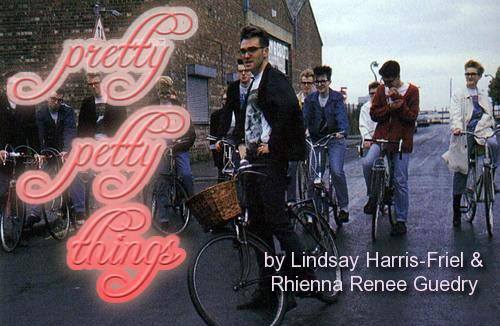
Tickets are now available for a showcase of Latino-American love for the man whose voice helped redefine masculinity, Morrissey.  The short plays are all culled from a nationwide call for submissions. I took a gamble with my friend, DJ and cultural connector, Rhienna Renee Guedry.  We wrote a play about bicycles, not having sex, and woman-loving-women who love Morrissey, and sent it in, crossing our fingers and clapping our hands because we believe in fairies.

A few weeks later, we were fortunate enough to have our play, Pretty Petty Things, chosen as a finalist.

Unfortunately, I’m unable to get to Los Angeles from Philadelphia right now. BUT, if you can, you should! The cast is not only talented and skilled, but also gorgeous. The show promises to be a tour de force, complete with live musical performances and a lot of sweet and tender hooliganism. It’s only playing for one night, Thursday, November 13, at eight pm.

@Jules Dee Photography, 2014. Jeanette Godoy and Moises Rodriguez in rehearsal.

How often do you get to see a theatrical event that combines Latino contemporary life and California culture with the Anglophilic pop sensibility of the former frontman of The Smiths? Come to Casa 101 Theatre, 2102 East First Street, Los Angeles, California, 90033, for a singular dramatic event.

Tickets available at this link!  Go get ’em, Tiger!


Who would win in a fight?

Bill Hader hosted Saturday Night live this past week, and, surprisingly, ranked historically low ratings. Despite Hader’s status as an SNL favorite and his new movie, The Skeleton Twins (with fellow SNL favorite Kristen Wiig) out in theaters, even I didn’t watch it. I like Bill Hader, particularly for his bizarre portrayal of Julian Assange.

The one character that seems to resonate most with the zeitgeist is his adorably esoteric nightlife pundit, Stefon. His mannerisms- the face-covered giggle, the sleeve plucking- remind me of my nephew, and his love of surreal entertainment usually cracks me up.

Honestly, I think I’ve been to some of those parties, particularly when Vince was playing with The Absinthe Drinkers. Preponderance of guests with mechanical arms? Check. Improvised jazz theramin? Check. Woman using a live python as a hair ornament? Check. Three witches making out under a giant paper-mache tree? Check.

Two things bother me, though. Hader’s inability to keep from laughing on camera rubs me the wrong way. I don’t find it as endearing as  the character. It’s wonderful to be reminded that this is live, and chaos can happen, but it just seems like whoever’s operating the teleprompter is playing a joke on the audience.

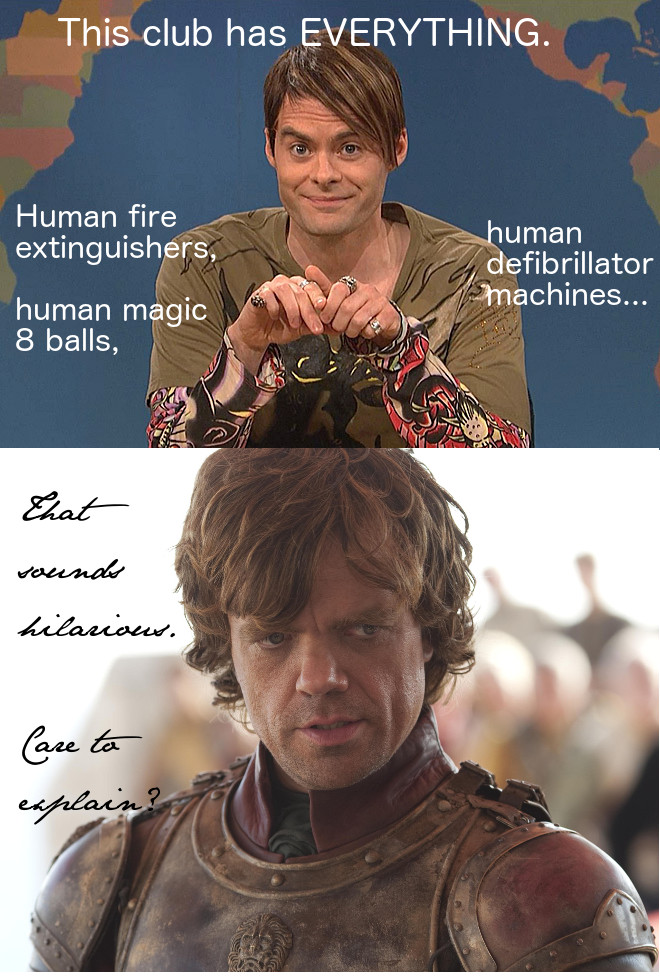
The other bothersome thing is when Stefon’s love of the freak-show element becomes the disturbing recurring gag about human machines, which inevitably turn into some kind of riff on dwarf-tossing.  If it were a woman being shaken until she says “ask again later,” it’d be rapey; if it were a person of color, it’d be censored. True, Stefon’s descriptions are lavished with variance in ethnicity, gender and age, but a person being used as a machine seems less consensual and more cruel.

Peter Dinklage has appeared on SNL’s Weekend Update, as a Drunk Uncle, and he was no stranger to cruel humor. It’s surprising that SNL’s writers would continue to make the human machine joke, if the popular, award-winning and really fucking smart Dinklage is a friend of the show.  What I’d really, really, really love to see, is for Stefon to get started on one of his explanations of human traffic cones/fire hydrants/boom boxes/suitcases/kites/piñatas/Magic 8 balls/whatever, and have Dinklage slowly, deliberately, roll up right next to him, just out of his line of sight.

stefon-tyrion

I mean, come on, writers. If you’re going to do rough comedy, do it in an interesting way.


Comments and Search Terms, or SEO Writing and Pat Smear

IMG_2296  SEO (Search Engine Optimized) Writing seems to be the main topic of interest that anyone ever comments about here on this little blog of mine. It’s fascinating. With all of the writing that I and sometimes my husband do about pop culture, music, theatre and the occasional recipe for canine cuisine, the one weird trick that always comes through in the Comments section is something like this:

Good morning writer and hello to you your website should have more traffic driving it I can make with SEO content your website traffic increase by one thousand and ninety seven percent, SEO is the wave of the future just like jetpacks and flying cars SEO Writing is a rare and highly specialized skill to use SEO keywords optimized to bring the highest Google results and increase your market potential my SEO experience and background in writing fluentest English extensively can bring SEO to your website now and make lots of more big dollars for you and myself huge potential contact me now sir more info about SEO Writing. 

To which I say, wow, thank you for the word salad, and hit delete.

I’ve done a fair amount of SEO writing, and I’m not a bad SEO writer. A client contacts me, because they want some content on a particular topic for their website, and they want someone to do the research and write about it in an accessible way.  They tell me how many words they want, usually around 300-500 per article, and what topic. I research it, write about it, rewrite it again to make it more concise and reader-friendly, and send it. They pay me, and everyone’s happy. They get clear, concise, accessible, researched website content to explain more about their product or service, and I get paid to do something at which I’m good and that I enjoy.

800px-Stipula_fountain_pen  The difference between SEO writing and other kinds of writing is the search engine optimization.  In order for the article to rank highly in search engine results, it has to use the same keyword as many times as possible. So, if you write an article that used the phrase “SEO writing services” once in the entire 500-word article, its page won’t have as high of a rank as, say, one that includes the phrase “SEO writing services” seven or eight times in those 500 words.

Now, when I was a wee lass learning to write out on the Quaker farm, where we still used paper and pencils, we were taught that repeating the same word too many times is tiring to a reader. And of course, since it was a Quaker school, wasting paper and graphite was a terrible sin. We learned not to bore our audience by repeating the same word over and over again. Sadly, the Internet was a gleam in the eye of a developer, and “page rank” was never discussed in seventh-grade writing classrooms.

But now, in the writing marketplace, repetition is good. However, a good SEO writer has to find inventive ways to make sure that the finished product is a clear, informative, helpful article with genuine information. It can’t just be a string of keywords, like a pattern of colored beads.

Currently, on Elance.com, writing is the second most high in demand skill, second to Web design. You’d think that a good SEO writer would be working 9-5 every day and making $40 an hour. Unfortunately, the offers are very strange, relative to the expected product and service an SEO writer provides.

As I write this, mostly based on experience, my current word count is 618, and it’s taken me roughly 20 minutes. I’ve barely done any research on this topic, other than a few quick glances at Elance. If I were to write an article with citable examples and footnotes, it would have taken longer. Furthermore, a shorter article takes more time, because of the thought process involved in condensing a topic. There is a reason that the haiku is an art form.

Most clients offer, for a 500 word researched article, using SEO writing, less than five dollars. I have been offered as little as six-tenths of a cent per word.

I have been fortunate, in that clients I’ve worked with have paid more, and they’ve been happy with my work. Unfortunately, these clients are few and far between. It’s really sad that the ability to write well is so undervalued, and it sincerely makes me wonder what I’m doing with my life sometimes. But, I’m really good at this, I can’t stop doing it, and this is what I want to do for a living.

In other news: The search terms used to find this blog, relative to the actual content, are often interesting. I think of this as a place for us to write about our music and theater projects. The most popular search terms used to find this blog are as follows:

m/s song of norway david bowie t-shirt

what strings does paul weller use

bowie video thank you for shopping

Now, I don’t know if I want to turn this into a British blue-eyed soul blog, but maybe there’s a play in this somewhere. If people are mostly interested in the secret hidden meaning behind David Bowie’s marketing artifacts and Paul Weller’s string choices, bless their hearts, they’ve come to the right place.

Only one of the search terms used to find this blog was phrased in the form of a question, and it’s a good one. I’ll try to answer it.

I am 16 do I need pat smear

"Patsmear" by Andrewbootlegger at English Wikipedia - Transferred from en.wikipedia to Commons.. Licensed under Creative Commons Attribution-Share Alike 3.0 via Wikimedia Commons -
“Patsmear” by Andrewbootlegger at English Wikipedia – Transferred from en.wikipedia to Commons.. Licensed under Creative Commons Attribution-Share Alike 3.0 via Wikimedia Commons

Pat Smear is, of course, a guitarist in the ubiquitous Foo Fighters, and was occasionally an additional live guitarist for Nirvana. Both bands are and have been among the most popular music in America, and I’m sure that if you turn on any rock or college radio station in America and wait a few minutes, you’ll certainly hear “Learning To Fly.”  I’m not saying that this is a bad thing, it’s just that it’s everywhere.  So since you phrased your question in terms of need, I’m not sure that they answer is yes.

Could you benefit from Pat Smear? Sure. But do you need to seek his work out, like a signed first edition of To Kill A Mockingbird?

If you’re going to do that, I recommend starting with work more indicative of his particular style than the latest Foo Fighters album, or Nirvana’s MTV Unplugged In New York album.  I think it’s time that you catch some Germs.

Okay, you’re sixteen, which means that the Los Angeles punk scene’s heyday was long before you were born. The Germs, however, are widely considered to music historians as one of the most influential bands in punk. Pat Smear played guitar, Lorna Doom played bass, Don Bolles was the drummer and their lead singer was Darby Crash.  Joan Jett produced their one studio album, (GI), in 1979. Despite critical acclaim for this album continuing to the present day, the band broke up following Crash’s suicide in 1980.  You may want to get your friends together to watch Penelope Spheeris’  documentary The Decline of Western Civilization, as well as the biographical film What We Do Is Secret. 

As you’re watching this, take a look at how these individuals were able to rebel against corporate capitalism without using the Internet (to say nothing of cell phones or Pitchfork), as well as how women presented themselves as agents of their own fortune and/or victims of male rebels. Ask yourself, what is victimization, and what is power, and how do these individuals make use of these systems of domination and control?  Do they win or lose? How and why? Then pick up a copy of (GI), and congratulate yourself on confusing the hell out of your parents by embracing an important part of American history.

At age sixteen, do you need Pat Smear? Yes, but you also need Joan Baez. You need music that will fan the flames of your adolescent curiosity and ambition and fuel you to make the most out of your life. Go for it.

I realize that it is entirely possible that what you meant to write is “I am sixteen do I need a pap smear,” in which case, that is a personal decision you should make with a doctor or nurse practitioner.

However, if you are really concerned about cervical cancer, here are some resources which may be helpful.

Pap tests and HPV tests, Planned Parenthood

Is a Pap test necessary every year? by Debbie Saslow, PhD

New Guidelines Discourage Yearly Pap Tests, by Mikaela Coney, ABC News

It’s a full-service blog here, I will tell you what. I can provide excellent music advice and SEO writing.

Any questions? 

You have never been in love until you’ve seen the stars reflect in the reservoirs

140514-morrissey-twitter-follow-tweet  Earlier this summer, I was browsing through different lists of playwriting opportunities, and I found one that reached out to me like a beacon in the dark.

TEATRO MOZ,  sponsored by Real Women Have Curves Studio, is sponsoring a short play contest. Do you have a dramatic memoir about the first time you fell in love with this Charming Man? Do the lyrics or title of a Smiths/Morrissey song inspire a story in your soul? Submit a short MOZ-themed play for a chance to win prizes and a staged reading of your piece by professional actors later this year!

I thought, that sounds so crazy it has to be fun.  I know next to nothing about Morrissey, but I bought “You Are The Quarry” when it first came out, and loved “Irish Blood, English Heart.”  I listen to The Smiths’ older hits quite a bit, and the sense of desire and longing, maybe desire for desire itself more than fulfillment, speaks to my inner gay man. Usually themed play contests and showcases are about heavy topics, but I’ve never seen anything like this before. I thought, I love this.

Morrissey blue satin jacket  So, I sent a quick e-mail to my friend Rhienna. She is a DJ and creative connector (as DJs tend to be) in Portland, and every year she runs the annual Morrissey Mobile Disco bike ride as part of Pedalpalooza.  Basically, a lot of people get together and ride a pre-planned course, with decorated bicycles, Morrissey look-alike outfits, and, of course, music, music, music.  I thought if anyone knows anything unique and fun about the phenomenon that is Morrissey, she does.

We had a cross-country confab. Oddly enough the deadline for the play contest was immediately following the next annual ride, so she had plenty of fresh material. We talked about Morrissey, his cancelled tour dates, loving him from afar, how his appeal transcends boundaries of sexuality and gender, and how the ride is a really fun time.  and how riding bikes with a group on a gorgeous summer evening is a fun young and in love or in love with love thing to do.  Their course’s goal was the Joan of Arc statue in Coe Circle, and since it’s beautiful and Philadelphia also has a Joan of Arc statue, I had to work that in.

She gave me a lot of information, helped me sort through ideas, and I typed it up and sent it.

Today, we got an e-mail from Teatro MOZ that Pretty Petty Things was picked as one of ten finalists! Which means it’ll be in the showcase!

Morrissey and good-looking men on bicycles


Not only am I excited about this, I’m excited about what this means. Basically:

Someone in LA loves the phenomenon that is Morrissey and his music to say, “let’s put up a short play festival about this thing I love.”

And a professional theatre said, “Sure. This is new, this is different, yes, we’ll back it.”

And they sent a call for entries out.

Meanwhile, in other cities in other parts of the country, two women said, “You know what, that sounds like fun and it’s something I know a little bit about, I’ll work on something and send it in and if they like it, they like it.”

Basically, once again, as Lorna Howley said, what is theatre but a big party?

I love the idea of people getting positive ideas and putting them together to make something bigger and better. which, in my opinion, is what theatre is all about. 

and I can’t wait to find out why the celebrity judges are. I’m secretly hoping for Thomas Lennon.

tumblr_ltw84b5cng1qafrh6


Hello?

This is specific enough to be odd.

Today someone in the UK visited this blog five times, specifically pages referring to Traveling Light.

So, uh… hello? I can’t see what your search terms were that led you here, but if you want to discuss the play, let me know.

Thanks for stopping by.

A public service announcement regarding your health and well-being.

tumblr_m9so5cg1iF1revsmeo1_500  ‘Tis the season for complaining about the heat, and keeping our mouths shut about one of the least fun by-products of summer: Other People’s Odor.  Sure, a little bit of someone’s musky personal scent is nice if you’re intimately involved, or would like to be.

Unfortunately, this time of year means that more often than not, you get exposed to an awful lot of the following:

  • Bacteria Stink
  • Cologne Stink
  • Both.

tumblr_mt59p7HiLO1qeyvhfo1_250  Or, at least, I seem to get exposed to an awful lot of the following, so please consider this a PSA from myself and most of the people who work with the general public during the summer.  There’s something about my workplace’s “movies and air-conditioning available at no cost to you” policy which attracts a lot of Pungent-Americans.

Being introduced to you in an olfactory way, before I can see or hear you, is not fun.  Sometimes it’s like having your open palm plastered up against my face without warning. Other times it’s more like your foot.  In urban environments, with a lot of car exhaust, open trash containers, and so on, bacteria in the air will be more likely to stick to your skin and grow smelly, without your being aware of it.

I’ve known a lot of people who say that deodorant and anti-perspirant are toxic and harmful. Another thing that’s harmful is not being clean. I don’t care what kind of magic crystals or baking-soda pastes you want to rub all over your tender parts, if you don’t start the day with a clean slate, you’re going to smell disgusting.  Even if you live on a diet of home-grown shredded carrots, alfalfa sprouts and springwater, and are directly descended from Saint Bjorn of Liliodeur, the bacteria on your skin will mingle with your nice healthy sweat and turn it into The Army Of Stink.

Which brings me to my next point.

It seems that the warmer and more humid the weather in this magic valley between two rivers becomes, the more people think artificial scent will cause a cloud of welcome to manifest itself around them.

Octopus running away saying NOPE
Overused? Maybe. Get you to pay attention? Possibly. How I feel? YES.

Remember how I said that if I smell you before I can see you, it’s like introducing yourself to me by booting me in the face? Okay. If I can smell your cologne, perfume, rare Arabian body oils, or what have you, it’s like having a pot of warm mystery chemicals dumped on my face. Some of you are so generous with your application of mystery chemicals that it leaves a trail behind you.

Flower, the Disney skunk character
Flower is cute. You might not be.

If your smell precedes you and leaves a wake, that is not good. It’s gross. It’s as if you’re an animal marking its territory. It’s gross if you’re dirty and smell like it, it’s rude if you’re spreading a chemical hangover, and it’s double plus creepy and sickening if you’re mingling bacteria, body stink and chemicals.

When I was but a wee lass, I remember reading in Cosmopolitan magazine, “Use scent to invite, not repel.” This is an odd thing for a magazine to have printed in it when it was full of paper cards painted with enough perfume samples to choke the censer department of the Vatican during Easter Week, but I digress.  Further, it said that if you could smell the perfume, you were wearing too much, because we can’t really smell ourselves generally. True, by that point, it’s too late. (Yes, I read Cosmo when I was a kid. I learned early about the war on women.)


Uncle George Takei's personal fragrance is a clean, bright, light scent.
Uncle George Takei’s personal fragrance is a clean, bright, light scent.

All human beings have their own scent, caused by genetics, diet, exercise, and local temperature. Layering the trendiest liquid on your skin isn’t going to make people like you any more or less (provided you were awesome to begin with). But sometimes it is kind of fun.  Drom Fragrances’ perfumer Kevin Verspoor offered these perfume-application tips to Allure Magazine. 

  • Applying scent to your pulse points intensifies the chemical reaction, because your veins provide heat. (Oh, wait, what was this whole thing about already? Not choking other people to death during the warm season?)  Even if the label says “body spray,” that doesn’t necessarily mean you should spray it all over your whole body.  He also suggest applying the scent to spots lower on the body, such as the back of one’s knees, further from the general population’s nostrils, to give it time and distance to dissipate.  I apologize to the vertically challenged.
  • Layer. Verspoor suggests layering a favorite cologne mist over a scented body wash or lotion.  In my opinion, be aware of what you’re adding and how they mix. If you’ve added Marlboro smoke, Budweiser and garlicky pizza to your body on a hot day in the last hour, no quantity of Hugo Boss will make you smell good.
  • A little dab’ll do ya, just like Brylcreem and Chinese Five Spice. Give the scent an opportunity to mix with your body’s chemicals and make a unique smell, don’t shove everyone’s nose into the bottle. You don’t need to re-spritz throughout the day.

tumblr_muxdhmDqNg1s8a3u9o1_250Please, out of kindness to your fellow summer-sufferers, bathe. The Axe Effect is (mostly) a lie. Hosing yourself down with a variety of unguents won’t hide your stink, it only makes it worse.  We know you know where the nearest public restroom is. Neither deodorant nor cologne should be a substitute for water.

Actually, nothing should be a substitute for water. Remember; hydrate, bathe, don’t overdo it.

For more information about How Deodorant Works, James May has a straightforward explanation for you.

Thank you. Have a wonderful day.

Maya Angelou and The Rainbow Connection

Some years ago, Maya Angelou gave the commencement address at the University of Delaware, where I was an (itinerant) undergraduate.  That year, many of my friends were graduating, so I wanted to attend the giant commencement ceremony to see them, but getting to hear Maya Angelou speak was A Very Big Deal.

mayaangelou

I Know Why The Caged Bird Sings had been in my English curriculum at Westtown, so I felt a really strong pull toward her. I had also had the extremely rare pleasure of hearing Coretta Scott King speak when I was young, and had a sense of the weight of history on both of these women.  So, I was extremely curious to know what Dr. Angelou would have to say to a football stadium full of mostly white, fairly privileged young people, when her career had included not only teaching and journalism in Ghana and Egypt, but also acting, singing, and working as a fry cook and a prostitute.

I can’t remember her entire speech, word for word, obviously, but one concept stood out for me most. She said that every single person there had achieved what they had today, because someone else had “been a rainbow” for them; given them a hand, a leg up,  written them a letter of recommendation, offered a second or third chance,  paid a bill or packed a lunch. She said that because of this, it was now their responsibility to “be a rainbow” for someone else, and pay that help forward.

I think of this all the time and try to incorporate it in my life. Sometimes it means saying no, and sometimes it means saying yes.

Rest in Peace, Maya Angelou. Thank you.

What’s the one weird trick for absolute success?

Oh boy! One weird trick!  Dermatologists hate me! Mortgage lenders curse my name! Why? Because I know the one weird trick that will help you, yes, YOU, pay off your mortgage, get rid of your wrinkles, reduce back and belly fat, and crack your script into shape to ensure total and immediate Hollywood screenwriting success in just minutes!

All of this is a gross exaggeration for comic effect, but you knew this, Gentle Reader. However, it’ll be interesting to see if my SEO skills result in some interesting search engine terms leading readers here.

Once upon a time, I knew a struggling actor, beginning playwright, and reasonably successful waiter. Just one? This one in particular, let’s call him Phil, had some bad networking habits. He was a schmoozer, and he was pretty good at getting into conversations about the business of making art with people more advanced in their career than he was. If you’re in any aspect of art-making, this will probably sound very familiar to you.

This is the guy he would usually bother. he has the patience of mountains, yet somehow Phil would still find a way to test it.
This is the guy he would usually bother. He has the patience of mountains, yet somehow Phil would still find a way to test it.

Inevitably, once some cheap wine or craft beer was flowing, and people were warming up, he would find whoever it was in the room that seemed to be the most advanced or successful in their career, corner them, and interrogate them, asking, “what’s the one thing, the one thing, the one piece of advice you can give me?”  By then his interrogation had driven away anyone else, and the interrogated would be shuffling and hemming and hawing, until finally they muttered something about perseverance, and said anything Young Torquemada wanted to hear so they could slip out of the conversation.

What was never clear (to me, anyway), was whether:

A) he only wanted to know one thing, because he didn’t intend to take up too much of their time with his request for professional guidance

or

B) he thought there was one secret to success, one ring to rule them all, which could be easily summed up in one simple weird trick, task, or dance move.

The reality, as anyone with half a brain knows, is that there is no one weird trick that will get anyone where they need to go. While it’s true that someone’s life can be ruined with one weird mistake or choice, getting where you want to go takes many steps, lessons, and actions over time. Very few people get this until they’ve learned it the hard way (myself included). That’s why I’m using a bold font. 

Me, waiting in a stairwell at the Temple Performing Arts Center, to go get my degree.

This past Thursday, I graduated with my Master of Fine Arts degree in Playwriting from Temple University.  It was crowded and hot and fun and thrilling, and a big vindication of all the hard work I’ve done over the past four years. Now I have a bunch of scripts, an MFA, a rail pass, and a copy of Writing Movies For Fun And Profit. I can take the train anywhere I want (at least through Sunday at midnight, and as long as I’m not planning to go past more than 2 SEPTA transit zones).

I also have a lot of new neural pathways burnt into my brain, from a four-year regime of writing, rewriting, reading, reciting, reiterating, re-reading, re-rewriting, researching, rehearsing, late nights, early mornings, too little sleep, too much coffee, and occasionally too much bourbon.  I’ve built some good habits and learned a few things. Which means I think now is the only time in my life that it’ll be fresh in my mind to address the question I was asked, back at the beginning of this process:

“Why do you need to go to graduate school to be an artist?”

IMG_2359
This is what I do. Not only do I make puppets, I sew berets and knit scarves for them.

It can be assumed that art is subjective, originality is more important than craft, that meaning is in the perception of the beholder, and maybe learning too many of the conventional rules of art-making can destroy creative impulses. Therefore, graduate school could, effectively, stifle real originality and creativity.  There’s the NYC vs. MFA debate (as if New York is the only city in the world where anyone does creative work and gets paid for it), where some people feel that rather than attending grad school, young people should get a job in their preferred industry and do it until they become successful.

Some of this is true. Some of this is not. I would make the argument that work and education need to co-exist. The ivory tower can insulate and stifle, and the working world can make you honest, but wear you down as well. You need both to improve as an artist.

Prior to applying to graduate school, I had a pretty good cultural education. I had worked in a lot of theaters where I had the opportunity to see world-class plays, music, dance, and whatever the Flying Karamazov Brothers are, for free, as long as I didn’t mind standing in the back. I heard Randy Newman play from the trap room underneath his piano, I saw the first production of Anna In The Tropics from 8th row center in a 300-seat house, I’ve been hugged by Dael Orlandersmith and kissed on the cheek by Tom Stoppard. For ten years, I absorbed all the culture I could, read tons of scripts,  and sold probably thousands of tickets and subscriptions.  Through this experience, I learned a lot about playwriting. Some of it I learned in weekly writers’ workshops and self-producing. Some of it I learned by seeing what shows were selected every season and where, and what wasn’t.

One does not simply walk into Mordor-blank
You’re thinking it. Right now. Yes, you are.

The biggest thing I learned is that if you don’t clean up real pretty, you don’t get asked to the dance. The competition for what I wanted to do was so fierce that if I didn’t have the MFA making me stand out, anything else that would was probably The Sarah Kane Solution.*

Right before I started graduate school, I was asked, “How is going to graduate school going to make you a better artist, something which relies on originality?” and I finally said, “I don’t know, but I have to try, because I can’t work the overnight shift at the big-box craft store for the rest of my life.”

So, here’s what I did learn in graduate school, how it changed me, and why I would advocate a mix of graduate school and “real-world” work in order to improve as an artist.

IMG_2046  First of all, as Polly Carl said, it’s a terrible idea to go directly from your undergraduate years into a graduate writing program. You need to go out and make mistakes and get scared in order to fully understand risks, stakes, consequences and motivation. Many playwrights who come from Ivy League universities produce scripts which suffer from the consequences not of the stakes needing to be higher, but the consequences of your protagonist not reaching their goal be a fate worse than death. If you spend your summers playing piano and tending bar in Brooklyn or Prague while reading poetry, or using the word “summer” as a verb in Cape Cod, you don’t know what a fate worse than death is. You need to get lost in very bad neighborhoods, and find your way home all by yourself.  You need to run completely out of food but still scrape up enough change to buy enough kibble to keep your cat alive. You need to work double shifts for a bad boss and too many customers and ache like you’ve been beaten with hockey sticks with no end in sight. You need to get so broke that you will do anything to get enough to eat, and then do that anything. You need to let time and tide and experience work on you. You need to learn the hard way who your real friends are.  Then, when you do get a good job, survive the night, see the sun rise, sink your teeth into that excellent meal, you need to let yourself feel real, heart-warming gratitude and pay it forward.  After all that, you’ll have something to write about.

IMG_2369  Secondly, it is true that graduate school insulates you from the “real world,” but this is a good thing. Effectively, it is a safe space to make creative mistakes. If you make mistakes in a job, you get fired, so you learn very quickly not to make mistakes. What you’re really learning is what your boss, client, etc. wants to hear or see. So, you might not create the most meaningful or affecting work, but you might create what gets you paid. Then you’re making the work that makes the groupthink happy and innovation doesn’t happen. Next thing you know, you’re buying up creativity books and going to seminars on “Five Highly Effective Ways To Think Outside The Box And Move Their Cheese.”

So, okay, yes, in grad school you get some playground time, and this is necessary in order to learn new ways of thinking.

When I wrote plays back in 2009, I used to type drafts directly into my computer, maybe very rarely handwriting if I had to.

IMG_2365
Just before MFA Playfest, May 9, 2014. Audiences are the best thing EVER.

Now, I storyboard and collage through idea generation, use a whiteboard through organizing my thoughts and structure,  type in Final Draft, and scribble throughout the process on paper. I also listen and talk out loud. I’ve traded various iterations of the same sentence back and forth with director Liz Carlson to find the right blend of craft and intention. We had a great time trying to figure out which was better, “lie back with your bed full of cupcakes,” or “lie back in your bed full of cupcakes.” I’ve done improvisation and used puppets to find new ways of telling a story. I learned from the most powerful brains in art-making fields, all with widely varied perspectives and methods.  If I had been in a for-profit work world, the opportunity to learn from leaders, make mistakes and try again would never have happened.

It’s true that Mark Foster of Foster The People honed his skills in commercial jingle writing, and John Hodgman sharpened his scholarly sensibilities as a literary agent.  However, these artists also were able to use grassroots and non-traditional media to create their own sandboxes. “Pumped Up Kicks” garnered its initial success via a free download on Foster’s website. Hodgman wrote a column for McSweeney’s Internet Tendency and now hosts his own podcast, Judge John Hodgman.

This dog has a frog. Were I cornered at a beer-and-cheap-wine fundraiser, by someone like Phil, and badgered for the “one weird trick to ensure success” (See how great my SEO skills are? You guys can stop spamming me now),  there would be a lesson I learned the hard way, to which I would refer.

In my second year of graduate school, I was working on a docudrama, which I grew to loathe. It dealt with a brutal murder, a woman falsely convicted via the court of public opinion, and her exoneration. The source material was so savage it gave me nightmares.** Writing this play was Not Fun Anymore.

IMG_2296  Now, if you have a situation where you work nine to five and make your art on the weekends and in the evenings, you can, and probably should, walk away from it when it’s no longer fun. If you’re doing it for love, and the love is gone, don’t stick with it. If you’re making a project for money, and you don’t love it, you’ll take the path of least persistence and do what the money wants. Client wants a beagle with mustard-colored ears on the label, you’ll make the beagle’s ears mustard-colored, even though you know caramel would be better. But, in this situation, failure to take this painful situation and not give it the honest illustration it required, would mean disappointment from people I admired, and in myself.  It would have been failure without honor. I needed to rely on craft to carry me through the emotional pain of this project.

IMG_2228  So, I dropped back, took a good look at the project, and thought about what it was that brought me to this project more than anything else. The idea of being tried in the court of public opinion was the one thing of which I could not let go.

I invented a new character, Lucky Moskowitz. Lucky is a 35-year-old lesbian who wears a lot of black, has black spiky hair, big blue eyes, and runs Lucky’s Gas n’Gulp out by the Interstate. She comes from a Chicago family of cops, but moved to the heartland to get away from a painful past with a mob-related former girlfriend (none of this ever came up in the play, but it sure is fun). Lucky gave me a means to tie together the disparate strands of the play and move the plot forward. Everybody comes through Lucky’s Gas n’ Gulp, and everybody’s got an opinion.  Lucky’s presence allowed me to look at the story in a new way.  The point is, eventually, you will hate a project so much that it is impossible to continue in the same way you always have. Then, you have to get perspective, and either find or invent a new personal point of entry into the work.

IMG_2363  Then you have to do it again and again and again, using the right tools and with the right people, until it becomes second nature. Then you have to forget all that, back up, take a good look, and just do it.

I don’t think an MFA alone is superior to real-world work, or vice versa. Neither is superior or inferior to building one’s own sandbox and using new technologies to find an audience. I think all these components have to work together. I do know that I’m definitely a better, more confident artist with more tools and techniques for play writing and screen writing now, after four years in the playwriting trenches at Temple University, than I was in 2010, left to my own devices.

Picard has had enough of your weird tricks.
Captain Picard has had enough of your weird tricks.

I believe that the one weird trick for absolute success is going out there and finding it for yourself.

That statement may seem like an oversimplification, and I don’t mean it that way. I could not have the portfolio of scripts, confidence, or neural pathways burnt into my brain without the teachers I had at Temple University, or the colleagues. I am deeply grateful every day for their work, skill, and talent.  What I mean is that the journey is the destination, and the goal is the work is takes to get there.

———————-

*Which would make a brilliant band name.

**I dreamt that I was employed by a tourism board to find all the haunted houses in a given area, witness the ghosts living out their own murders, write them down, and make it into a book to sell ghost tours. After describing the dream to my prof, Bob Hedley, he suggested I take a couple of days off from the work.

IMG_2228


Website Powered by WordPress.com.

Up ↑