You want to come see Traveling Light. I haven’t been writing much lately, but other people have been, and the hard work of the production team and actors is coming to fruition in a delicate and multifaceted setting. Fortunately, so far our coins in the wishing well are echoing and rippling rather nicely. Playwrights work in planned obsolescence; you write and hope that your work will be handed off to others who will include enough of themselves that the piece can live on its own. So far, this theory holds up beautifully.
RepRadio came to rehearsal so we could talk about things. if you like to listen to conversations about theatre, RepRadio should be on your short list of podcasts. Darnelle Radford is really good at bringing out what’s best about theatre in this area.
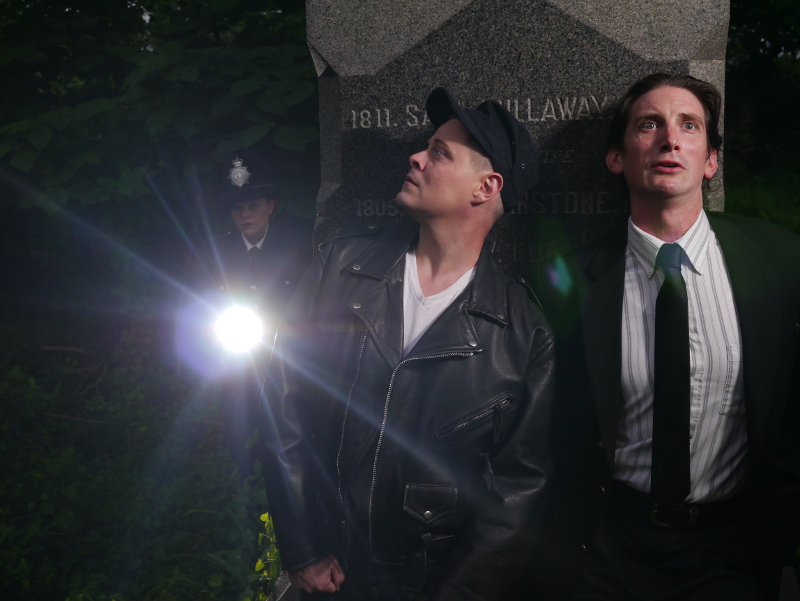
Last night, Kyle Cassidy came and took photos of the final dress rehearsal. Having a photographer present seemed to give the actors a strong sense of how they relate to space and each other and remind them of physicality. Kyle has an excellent ability to use light to create texture and palpability in his photos. It also felt like having Obi-Wan Kenobi with us, at the beginning and at the final dress, to bookend the creative process.
I’m going to put photos in a separate post, because they’re big and beautiful and speak for themselves, but for now, here’s a taste:
Officer MacDonald (Terence Gleeson) on the hunt for sexual deviants, as Joe (Doug Greene) and Brian (Bob Stineman) try to blend in. Photo by Kyle Freaking Cassidy.
Last night, as I was getting ready to leave for rehearsal, Vince was sitting on the couch eating a big plate of poached haddock and brown rice.
VINCE: I found out something really important.
ME: What’s that?
Bobbie Gentry’s haunting ballad, Ode to Billie Joe, peaked at #1 on the US Billboard Hot 100 chart.
VINCE: The truth about Billie Joe McAllister and The Tallatchee Bridge.
ME: Really.
VINCE: Mm-hm.
ME: What’s that.
VINCE: He didn’t jump.
ME: No?
VINCE: He was pushed.
ME: …
VINCE: Think about it.
ME: I am.
VINCE: Why would the narrative voice be filled with so much guilt in the second half of the song, if not to cover a crime for which she’s nearly caught?
ME: But… she’s got an alibi. She was down in the field balin’ hay. Or her brother was balin’ hay and she was chopping cotton or something.
VINCE: But Billie Joe McAllister didn’t just jump off the bridge. Not that morning.
ME: When did he jump?
VINCE: The song doesn’t say. But he had to have jumped the day before, otherwise how would the mother know and bring it up so casually at the lunch table?
ME: Okay, but an admission of guilt doesn’t mean anything, what’s the motive?
VINCE: Well, that’s the big mystery, isn’t it?
ME: Where did you get this information?
VINCE: I just thought of it, right now.
Now that I think about it, and after double-checking with lyricsmode.com:
Billie Joe McAllister couldn’t have been pushed by the narrator, because the mom reports “Today Billie Joe McAllister jumped off the Tallahatchee Bridge,” and the narrator has an alibi and a witness.
But you know who doesn’t have an alibi? The mom. I think she pushed him.
Oh, sure, apparently, she was cooking, but none of the food she served is stuff that requires close supervision: the black-eyed peas could have been on a low simmer and the biscuits could have been in the oven for a long time on low heat, as could the apple pie. And there’s no proof that the food was served hot, she could have cooked it the day before. Also, the father mentions that they have forty acres; a family living on a farm or ranch that large wouldn’t have found out about a suicide investigation that quickly without first hand knowledge.
And, Mama does have a motive, because she’s trying to set the narrator up with the preacher.
And she shows absolutely no remorse. Clearly, Mama is the cold-blooded killer.
So, here’s some of what we were up to at Mount Moriah Cemetery. Again, Kyra Baker as WPC Foster, Doug Greene as Joe Orton, Bob Stineman as Brian Epstein, all photos by Kyle Cassidy.
“do you know the story about the woman who had to be buried in the wall of the graveyard?”
“It’s not that Imelda Marcos is evil, per se; it’s that she sent the entire frigging country after us.”
Only seven weeks to Opening Night.
Performance Summary:
Traveling Light by Lindsay Harris Friel, directed by Liam Castellan.
Produced by Liam’s Sofa Cushion Fortress, September 6-14, 2013
at the SkyBox at the Adrienne, 2030 Sansom St 3rd Floor, Philadelphia PA 19103
Ticket Prices: $20 (tickets $10 on 9/6)
Tickets: at the door or www.fringearts.com or call the Festival box office
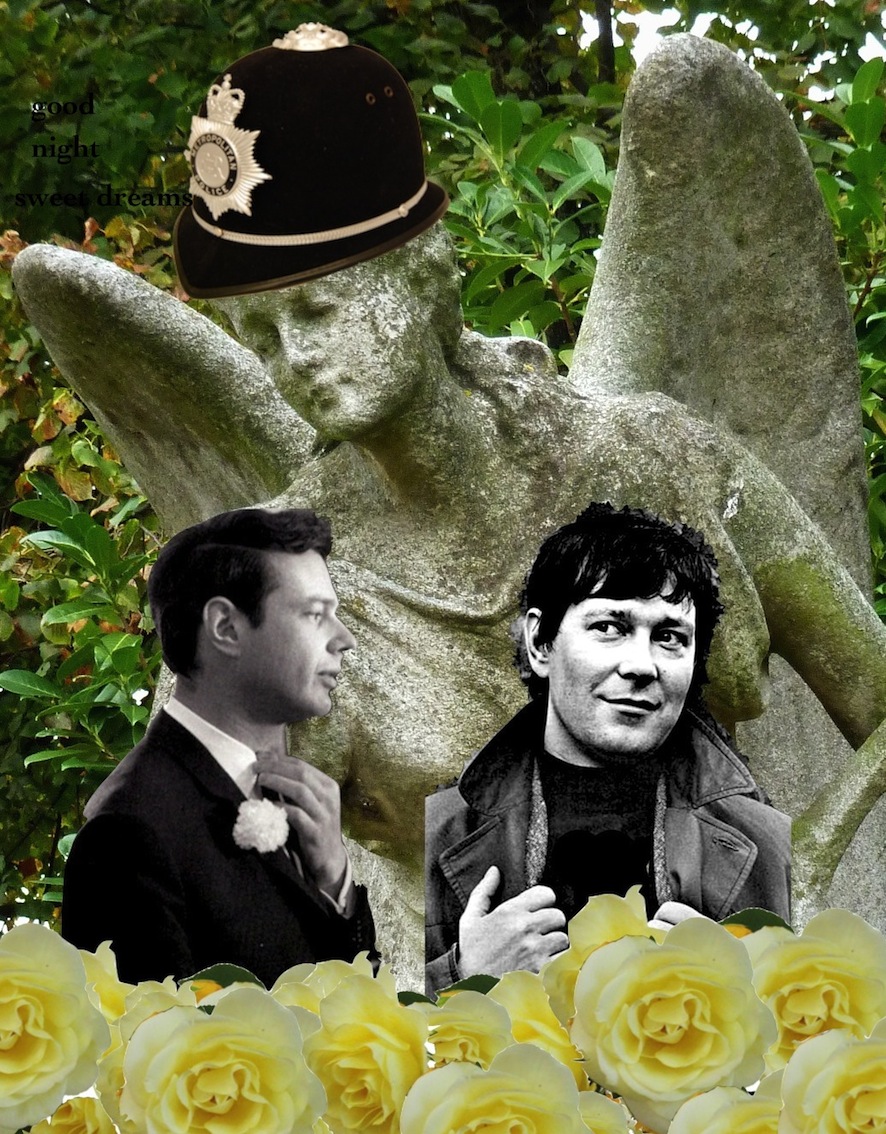
Traveling Light makes its Philadelphia premiere this September in the Philly Fringe.
Once upon a time there was a young man who heard some really beautiful music. He’d dedicated his whole life to aesthetic pursuits, but when he went down into a dark cavern and heard the beat and the harmony, he knew he had to bring that beautiful music up out of the dark and polish it and present it to the whole world. This music became bigger and stronger and more beautiful, until finally it could move on its own, and it was too heavy for him to carry any more, and it threatened to break him.
At the same time, there was another young man, almost exactly the same age, who liked to tell stories. Unlike the first young man, he’d been surrounded by a lot of ugliness and anger for most of his life, and the best way for him to deal with it was to create stories in which tricksters gave the bad people the badness they created right back. He went to a school that taught all about beauty (strangely enough, the same school that the first young man attended), and the first time he tried to make something beautiful and strange, it was so strange that people got scared, and he was sent to prison. While he was in prison, he polished his process, and when he got out, he continued making things that were strange and odd and funny and sad, with a vengeance.
This was all at a time when the world was changing. It was easier to make your voice heard over miles and miles, and the world seemed to be getting smaller, and people were starting to realize that maybe if they started treating each other as equals, kindly, amazing things could happen. But sometimes, even that was abused, because it’s awfully hard to get rid of things like greed and jealousy.
The first young man said to the second one, maybe this beautiful music I manage and your odd and strange stories could be put together to make something amazing. and the second young man said, I’ll see what I can do. so the writer went home and wrote a story, and brought it back to the music manager.
and the music manager said, this is too much. this is just too extreme, and rough, and unusual, and I don’t even know how to describe it.
and the storyteller said, but you’re just the same as this kind of story, you’re indescribable in the same way. you’re also that which can’t speak its name for fear of prosecution.
Later that summer, the storyteller came home, to find the person he expected to be waiting for him, waiting, as always, but this time with a hammer and a jealous rage, and by morning, the storyteller was dead.
and twenty-one days later, the music manager took too much medicine that he thought he needed, and the next morning, he was dead too.
the story teller kept a diary. so did the music manager. those diaries are kept secret, as diaries should be. but some things happened that summer, and some of the diaries’ pages are believed to be destroyed. and nobody knows why.
that summer was called “the summer of love.” which is an odd name for a summer in which there were a lot of fires and war and riots and protest. there were also a lot of warm, sexy nights where people broke rules and did what their hearts told them to do.
this isn’t a dissertation. it’s a play. less factual, more fun.
——————————————————————-
It feels weird to be promoting this play in Philadelphia, now, when I wrote it years ago. The production in Minneapolis, by Theatre Pro Rata, directed by Natalie Novacek, is still extremely close to my heart, and had a lot of magic in its site-specific production at Layman’s Cemetery. Carin Bratlie and I still brainstorm and I still miss Minneapolis, the people I met there, and their commitment to making fun, brilliant theatre. After that production, I somersaulted straight into Temple’s MFA program, and it’s been hard to come up for air at all ever since.
I don’t want people to think this is the only play I’ve ever written, but it seems to be the one people like the most, and I’m deeply grateful that Liam Castellan said, “I am going to pick this play up and run with it.” and finally, this play gets to happen in my home town.
We have a cast. They’re beautiful. We’re still looking for designers and crafting press releases and planning photo shoots and so on and so forth. for now, I get to be so excited about it that I am forced to be experimental with capitalization.
David Bowie turns 66 today, and, true to form as a brilliant marketing person as well as an artist, he’s giving us all a birthday present. His new album is released today, with a new single, ‘Where Are We Now?’ with an accompanying video. The short film by Tony Oursler is as captivating as any of Mr. B’s other projects, a calm, pensive exploration of one’s place in the last 66 years.
He was born in 1947 (same year as my mom) into an England repairing itself from World War II. The tragedies of that time were so horrible it was believed that the human race could never, ever do anything so bad to its fellow creatures ever again. Of course, history has shown that humans have an amazing tendency to shoot themselves in the foot. Repeatedly. The video for ‘Where Are We Now?’ is crafted to show Mr. B’s diverse drives concerning his role as a pop artist in a world where disasters are quickly forgotten, covered by a fresh coat of paint and a pretty PR campaign.
The video opens with a shot of what appears to be a large, cut diamond, on a cluttered surface, at the center of a cold visual field. Most viewers will instantly believe this to be fake: glass paperweights and plastic tchotchkes like this sell everywhere from Tiffany’s to A.C. Moore. Later we’ll look at what the faceted jewel signifies and what it actually is. Don’t let me forget. (Cripes, hang onto your butt, because this could get more rambly than Quentin Tarantino’s famous speech from Sleep With Me about the homoerotic nature of Top Gun. But, the only person with a more calculated sense of image other than David Bowie outside of public office is Madonna, so no detail is in the frame by accident). The next shot is of a broken or disassembled frame without a picture. The glass is intact, and reflects a view of a street, with moving vehicles. It’s sort of a glass half empty/glass half full test: is this garbage, or is it a picture in and of itself? Or is it a symbol of two-dimensional art abandoned?
The point of view moves through a room, again with a cold visual field, cluttered with mismatched objects and evocative of abandonment or disaster. It finally settles on (again, ambivalently), what is either a pile of clutter or an arrangement of mismatched objects, like a still life or installation. The primary focus is on a screen, projected on which are street scenes in black and white, and a doll that appears to be a two-headed baby (which seems to be a not to Mr. Bowie’s embrace of circus freaks and space oddities, cuddly friendly ones). The faces are blank white pillows, on which the faces of Mr. Bowie and an unnamed woman are projected. Their faces are distorted by the projection, pulled tight, into barely-human masks.
As the song proceeds, the text of the lyrics is provided, bit by bit, complementing the rest of the visual experience. The song has the feel of a lullaby or a funeral song, dreamlike and peaceful but also somewhat disquieting, describing the experience of traveling in Berlin. The visual layout and pacing of the sung lyrics seems to be created specifically for this video to be watched online and compared with searches for the terms he uses. Of course, if you’re German, European, or any kind of a serious history student, the words are familiar. If you, like me, are 24 years younger than Mr. B and took American history instead of European, you might want some help from Google.
The song describes the experience of being in Potsdamer Platz, one of the busiest locations in Berlin, watching the crowd go by, on the Nürnbergerstraße, which is a popular shopping and tourist destination, looking at the KaDeWe, an elegant department store, and crossing the Böse Brücke. Today, these would be places where lots of commercial and tourist activity occurs, where supply and demand glitter and groove. However, the history of these locations is heart-stopping.
On November 9, 1989, the Böse Brücke was the first crossing point when the Berlin Wall fell, reuniting East and West Germany, completely changing the consciousness of the nation and the life of every German. The KaDeWe, or Kaufhaus des Westens, is the second largest department store in Europe. It has a greenhouse-covered roof housing a winter garden and restaurant, and anchors a boulevard of designer boutiques to rival any in Los Angeles. The business was founded in 1905, but the Nazis obviously decided to remove the mostly-Jewish management. In 1943 the building was nearly destroyed by Allied bombing, most notably when a plane crashed into the building. Potsdamer Platz itself was divided by the Berlin Wall and turned into a wasteland for much of the Cold War Era. Prior to that, its status as an important gathering place and trading post is recorded as far back as 1685, which made it a high-priority location for Nazi propaganda and offices.
Essentially, Bowie is pointing out that places of ancient plenty and pain are prettied up for profit, and asking “where are we now?” Have we improved as a society, or have we just given history a PR campaign? What does it mean to take places where people struggled and died and turn them into shopping malls?
Let’s go back to the is-it-or-isn’t-it-real diamond for a second. Think about what it actually is, and what it stands for. If it were real, a lot of people would have died to get it out of the earth, transport and protect it. It is probably a glass or plastic imitation of the idea of a giant flawless diamond, manufactured by the thousands in a factory somewhere in China. Think about how it stands out in contrast to the rest of the visual field here: barren gray versus “ooh shiny.” I don’t know about you, but, unfortunately, I live in a world where thirteen-year-olds fight over Louis Vuitton handbags. Not because they earn that kind of money or save up from a paper route or lemonade stand, but because their priorities (and those of their families) have become so wrecked by poor educations and too much advertising that they honestly believe that buying the latest fashion accessory is more important than anything else.
Never mind that this fashion accessory may have been made by a child who was paid maybe five cents a day to make it. Never mind that it was made in a factory in a country with such poor environmental protections that, all together, shopping in the Potsdamer Platz at the KaDeWe can set off a domino effect of money changing hands that results in the kind of widespread all-around badness that can still be as devastating as what happened in Berlin in World War II, just not all at the same time. So, not only are we sweeping tragedy under a very pretty rug, we’re also building another tragedy on top of it.
But, OMG I HAVE TO BUY THE LATEST SHINY TRINKET SO I CAN BE COOL LIKE KIM KARDASHIAN.
Oursler’s film places Bowie and Berlin together by showing footage from when Bowie lived in Berlin. This city and experience figured prominently in Bowie’s life, allowing him a place to get clean from drug use, and helping him create the albums Low, Heroes and Lodger. This film provides an opportunity for younger fans to get to know him, with its (aforementioned) multimedia-friendliness. It also allows older fans to travel down memory lane, back to when “Heroes” and “Boys Keep Swinging” really meant something. The lyrics say that he is in a “Dschungel,” or jungle; if you only hear this, it sounds almost exactly like “jungle” is the sung word. “Dschungel” is one of only three word in German that can be masculine, feminine, or gender-neutral. Bowie kicked down a lot of walls for men who liked to wear dresses and makeup, as well as women who liked to wear trousers and suspenders. In this song he isn’t the buoyant alien, or the wild rocker: he’s “a man lost in time, walking the dead,” (sung with the image of someone walking with a dog). The song never refers to the glitz of the shopping arcades, it could take place at any time in history. it’s a reflective story of a traveler walking with ghosts. Whether those ghosts are personal, political, or spiritual is unknown.
The climax of the song is the most universal part, evoking the love-conquers-all message of “Heroes,” with the simplicity of “Everyone Says Hi;”
“as long as there’s sun…
as long as there’s rain…
as long as there’s fire…
as long as there’s me…
as long as there’s you…”
The narrative states that as long as there is human companionship and kindness in balance with nature (sun, rain, fire), everything will be all right.
Disasters are on everyone’s mind this winter, as if they are ever far away. Berlin is a place of agony, where some of the worst of the human race’s offenses occurred. However, for Mr. Bowie, it is also a place of escape, where he created some of his best work and when he got clean. It’s a place of tragedy, commerce, and hope. Coming back to the diamond, we need to think about things (Berlin, Bowie, disasters, ourselves) as a faceted, like a jewel.
But, just who is David Bowie to pass judgment on the human race in the last 66 years of history?
When the images on the screen in the assemblage start to become most personal- point of view shots which take over the entire visual field, the film steps back to include Mr. B himself, looking at the multimedia art installation. Colorful objects are in the foreground, and a dog walks by, wagging its tail. Bowie is in the role of artist here. Despite the bits of warmth in the frame (the red text on the shopping bag, the ginger fur on the dog) he is in pain, clutching a notebook and pen- he’s at work, and his work hurts.
Again, nothing here is by accident. Bags with text saying “Thank you for shopping here!” can be found around the world and clutter every nation. The message, “Thank you for shopping” is not unlike George W. Bush’s message to the American people after 9/11. Bowie’s a businessman, an entertainer: he provides product to consumers. He’s not exempt from any anti-consumerist message, and his hands are no cleaner than anyone else’s. There’s another chunk of text in the shot that’s telling us something: Bowie’s t-shirt says, m/s Song of Norway.
So, just to recap:
he’s wearing a shirt
advertising a cruise ship (cruises being the easiest and most homogenized way to travel)
named after a Hollywood musical (starring Florence Henderson before she became Mrs. Brady)
named after an operetta (for people who find opera too much to handle)
based on a play
about composer Edvard Grieg, and his drive to create music that contributed positively and meaningfully to the national identity of his homeland.
Which really has to be a nod to how a musician creates something and it travels through time like words in a game of whisper down the lane, and eventually you have no way of knowing how you will be remembered or what your impact will be. You can go nearly mad writing “In The Hall Of The Mountain King,” and two hundred years later your music is on Bugs Bunny cartoons and your lasting tribute is a mode of travel for the terminally lazy.
(Oh, snap, I said that. I guess nobody’s giving me free cruise tickets now.)
What? Maybe Bowie always wears his cruise ship t-shirts when he’s just hanging out in the studio? Yeah. Right. The guy did a fashion ad campaign for Gucci, for God’s sake. I don’t think he leaves the house without four hours of planning and several drafts.
However, the last place where we see Bowie is not standing back against the wall with marketing copy. We see him as one of the faces on the conjoined-twin baby doll. After the woman removes her face from the projection, he steps back, but hesitates for a few seconds, as if reluctant to leave. It is as if Mr. Bowie is more comfortable being part of the image he creates than a person in real life.
Mr. B, like his own video, and the fake diamond at the beginning, is multifaceted and not without flaw. But, he’s pretty when the light hits him right, he’s here to entertain you and make you think. and, like a real diamond, he endures.
Yay, timely critical analysis of a short film, whoooohoooo! I gotta go read Ubu Roi now.
Okay, so here’s my quick review of the giant ham and cheese sandwich that is the Nirvana-McCartney shebang last night. which I did not see until 6:30 this morning, which was this recording, while making coffee.
0:04: Dave Grohl: I am totally gonna do that Namaste bow I learned from the hot chicks in yoga class. Yoga chicks love that shit.
0:10: Krist Novoselic: It’s cool, Sir Paul. Half the room has no idea who you are either.
0:21: Pat Smear: Everybody thinks I’m Fred Armisen.
0:22: Paul McCartney: I Am Gowing To Speaak In My Sir Pawl Vowice So Evaryone Knoows I Hawve Bean Knighted. And Sow I Wawrm Up My Vowcal Cowrds Awnd Down’t Crawk Like I Did At The Olympics. We’re Gowing To Jawm Owt This Rawk Hit.
0:26: Krist Novoselic: Okay, so I let my daughter pick out my clothes. At least I’m not wearing a rug that looks like a refugee duck from the BP disaster.
My thoughts about the music: When Novoselic said “It’s gonna sound like Scentless Apprentice and Helter Skelter,” he was right, but I think it sounded more like Come Together. Again, this isn’t the finest recording in the world, it’s pretty good, all things considered, and I hadn’t had my coffee yet, and I thought, of course it’s good. It goes on for 60 seconds too long, but of course it’s good. Your lead guitarist has been playing professionally for over half a century and basically is one of the inventors of the genre, your drummer has been playing in every kind of band since he was a teenager, your bass player has been hanging out for the last 20 years playing music for other people’s bands and saying, “fuck the system,” they’re gonna go through the standard book of basic rock riffs and throw all of them at the audience. I don’t know why they had to throw them all at the same time, they could have afforded to back off a little bit, go for finesse instead of bombast, but I’m sure Sir Paul could only give them two hours (including the performance night).
I’m also dying to know what kind of guitar Sir Paul’s playing here.
You know what would not have sucked? All things considered, if they had done this, which has no relation to a hurricane, but it sure would have been fun to listen to:
I just hope this means some more people get heat and electricity and food and clothes and stuff, who need it.
Blogging here has been thin, the semester has been thick. Right now I’m up to my nose in a work in progress and up against a deadline, but I promise some actual content after it’s all over but the shouting.
It’s that magical time of year, where I have to dig in, eschew all social contact, and sacrifice myself to finals. I’ve been spending the rainiest day in recent memory reading academic journal articles on Abstract Expressionism, and when this paper is finished and handed in, I will never want to look at a Jackson Pollock painting again. Maybe it’s oxygen deprivation making me feel compelled to overshare this with you.
I used to work at an upscale men’s clothing store down at the Jersey shore (just to give you an idea: men’s golf shirts, $50 each) that was so mind-numbingly boring that we used to place bets based on how overplayed the songs on the South Jersey lite FM radio station were (i.e., how many times will we hear this song this week?). There was a period of time where the song of the week was “Leather and Lace,” but they never identified the artists. We all knew it was Stevie Nicks and somebody, but we couldn’t identify the male vocalist. It took a full week before someone finally correctly identified it as Don Henley.
You know your job is mind-numbingly boring when you can write, in your head, a full gender-studies article on the cultural relevancy of the lite-FM chestnut, “Leather and Lace.” It made me fall in love with the song. It wasn’t a great summer, but there are worse fates.
Years later but still years ago, I convinced my friend Jeremy to sing this at karaoke with me. Being completely blotto, I blew it so badly that I still owe Ms. Nicks an apology.
So, that might explain why I find this pee-myself hilarious, at least through the first 4 minutes.
Ferrell’s comedy takes a while (and it’s not work-safe, you have been warned), but at 4:15 or so, Dave Grohl just takes it back and owns it (and me). I’ve never been a huge fan of, specifically, The Grohl- his presence is ubiquitous enough to have become cultural wallpaper at this point. But his ability to simplify and perform this overplayed song compellingly shows you why, much like Chickenman, he’s everywhere, he’s everywhere. Guy’s got some chops, and I wouldn’t mind that served up with some caramelized onions.
But then Ferrell breaks the absolute cardinal rule of the guitarist-worshiper. No matter how funny you think you are, no matter how complicated your bromance, YOU DO NOT DISTRACT THE GUITARIST. Guitarists in general tend to be skittery creatures, and it’s a complicated juggling act for them to perform and make it look like they’re not self-conscious. One wrong move and they will tear back to Mom’s basement, the six-pack of Schlitz and the stack of vinyl records before you can say Stairway To Heaven. Deep down inside every guitarist is a kid who finds a complicated, ancient and beautiful stringed instrument less threatening than people.
Musicians make good partners for writers. When you need to go crawl into a cave and scribble and scrape out a few hundred words and try to make sense of them, they will not miss you when you’re gone. They will, in their weird way. You might come out later on and find a mouse on your doorstep. In reality, they’re off doing their own scrambling and scraping. Whatever you do, when the machine is in operation, do not distract them. You might end up with a 12-string neck in your ribs, and you will deserve it.









 6630 Productions